
Imagine this sales conversation.
A salesperson confidently presents a product worth NPR 100,000. The customer listens carefully, appears interested, and then asks a familiar question:
“Can you offer a better price?”
Without exploring the customer’s concern, the salesperson immediately replies, “I can offer you a 10% discount.”
Just like that, NPR 10,000 disappears from the selling price.
But was the discount necessary? Was the customer genuinely unable to afford the product? Or was the buyer simply testing how much flexibility the salesperson had?
This situation highlights one of the most common challenges in sales: discounting too quickly instead of negotiating effectively.
Many sales professionals believe that reducing prices is the fastest way to close a deal. However, successful negotiation is not simply about agreeing on a lower price. It is about understanding customer needs, communicating value, managing objections, and reaching an agreement that benefits both parties.

This is where a practical Negotiation Skills Workshop can make a difference.
For organizations investing in sales training in Nepal, developing strong negotiation capabilities can help sales teams move away from price-driven selling and toward value-based conversations.
In this article, we will explore why premature discounting hurts profitability, the best sales negotiation techniques for sales professionals, how to handle customers asking for discounts, and how structured sales negotiation training helps teams protect margins while closing better deals.
Why Discounting Too Quickly Hurts Sales Profitability
Offering discounts is not always wrong. Strategic discounts may help businesses secure volume commitments, enter new markets, manage inventory, or strengthen long-term relationships.
The real problem begins when salespeople reduce prices before understanding what the customer actually needs.
The Hidden Cost of Discounting
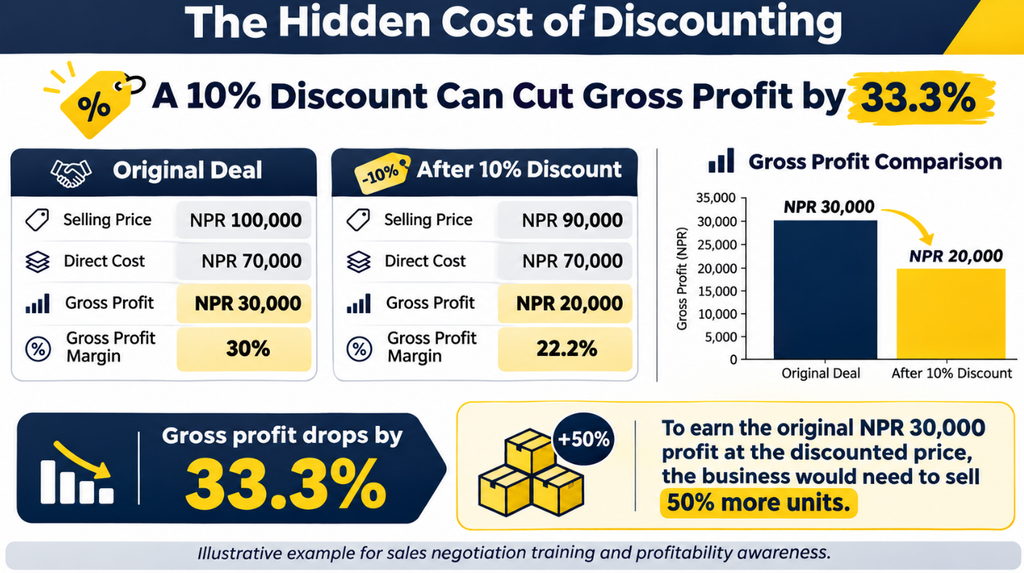
Consider a simple business example.
| Financial measure | Original deal | After 10% discount |
|---|---|---|
| Selling price | NPR 100,000 | NPR 90,000 |
| Direct cost | NPR 70,000 | NPR 70,000 |
| Gross profit | NPR 30,000 | NPR 20,000 |
| Gross profit margin | 30% | 22.2% |
In this example, a 10% price discount reduces gross profit by approximately 33.3%.
The salesperson may celebrate winning the order, but the organization earns substantially less gross profit from the transaction.
To earn the original NPR 30,000 gross profit at the discounted price and unchanged unit cost, the business would need to sell 50% more units.
This calculation demonstrates why effective sales discounting strategies are directly connected to profitability.
Closing a deal matters. Closing a profitable deal matters even more.
Why Salespeople Offer Discounts Too Early
Premature discounting often happens because salespeople:
- Fear losing customers to competitors.
- Lack confidence when discussing price.
- Focus on sales targets without considering margins.
- Struggle to communicate product differentiation.
- Assume that every price objection means the customer cannot afford the product.
- Have insufficient knowledge of customer priorities and decision-making processes.
- Lack structured negotiation preparation and concession management skills.
Sometimes the problem is not the product’s price. It is the salesperson’s inability to explain why the product is worth that price.
A structured corporate sales training program in Nepal can address these challenges through consultative selling, objection handling, negotiation practice, and coaching.
How Frequent Discounts Weaken Customer Perceptions of Value
When customers repeatedly receive discounts, they may start questioning the original price.
They may wonder whether the quoted price was realistic or whether another discount will become available if they continue negotiating.
Over time, this can create a discount-dependent buying relationship.
Customers learn to negotiate for price reductions, while salespeople become increasingly uncomfortable defending their offers.
The objective is not to eliminate discounts completely. It is to make every discount intentional, commercially justified, and connected to a business objective.
What Are Sales Negotiation Skills and Why Do They Matter?
Sales negotiation skills are the abilities sales professionals use to reach mutually acceptable agreements while protecting the value of their products, services, and commercial relationships.
These abilities include active listening, preparation, questioning, value communication, emotional intelligence, price objection handling, and concession planning.
Effective sales negotiation is not about pressuring customers or winning arguments.
It is about creating agreements that make commercial sense.
Selling vs. Negotiating: Understanding the Difference
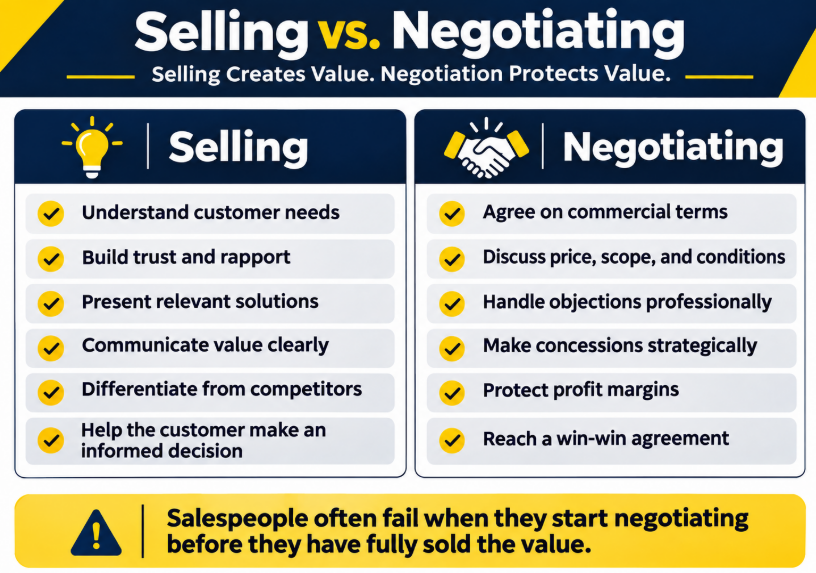
Although closely related, selling and negotiation are different activities.
Selling focuses on identifying customer needs, demonstrating value, building trust, and helping the customer understand why a solution is relevant.
Negotiating focuses on agreeing to the commercial terms of the deal, including price, scope, payment conditions, delivery schedules, commitments, and responsibilities.
For example, explaining how software can reduce manual reporting time is part of selling.
Discussing implementation timelines, subscription terms, and commercial commitments is part of negotiation.
Problems arise when salespeople start negotiating before they have successfully established value.
That is why strong selling foundations are essential. Our guide on how to open and close a sale effectively explores the importance of building a complete sales conversation rather than rushing toward the final agreement.
The Importance of Win-Win Negotiation
Win-win negotiation seeks an agreement in which both parties receive meaningful value.
The customer gets a solution that meets important needs, while the seller receives commercially acceptable compensation.
For example, instead of immediately reducing the price by 15%, a seller may propose a longer contract, a different service package, or a revised implementation schedule.
Such arrangements can create value without unnecessarily reducing profitability.
The Program on Negotiation at Harvard Law School emphasizes exploring different interests and trade-offs rather than treating negotiation as a battle over a single issue.
Why Negotiation Skills Matter for Modern Sales Teams
Today’s sales professionals often deal with informed buyers, competing offers, procurement departments, complex buying committees, and tighter budgets.
Successful sales negotiation techniques help teams:
- Defend prices with greater confidence.
- Understand the customer’s real decision criteria.
- Handle objections without becoming defensive.
- Avoid unnecessary or unplanned concessions.
- Maintain profitable customer relationships.
- Build trust through transparent commercial discussions.
Strong negotiation capabilities also support a more disciplined, consultative approach to selling.
7 Sales Negotiation Techniques to Win Without Discounting Too Quickly
If you want to learn how to negotiate with customers without discounting, these seven practical techniques provide a starting point.
1. Understand the Customer’s Real Needs Before Discussing Price
Before negotiating, discover what the customer actually wants to accomplish.
A customer requesting a lower price may be concerned about cash flow, uncertain about the return on investment, comparing competing proposals, or seeking approval from a manager.
Each concern requires a different response.
Instead of asking, “How much discount do you need?” try:
- “What is your biggest priority when evaluating this solution?”
- “What results are you expecting from this investment?”
- “Is your main concern the total investment, the payment schedule, or the expected outcome?”
- “Apart from price, what will influence your final decision?”
These questions shift the discussion from bargaining to problem-solving.
Effective negotiation begins with effective customer discovery. Read our article on how to connect with your customer effectively to explore how stronger customer relationships support better sales conversations.
2. Sell Business Value Instead of Focusing Only on Price
One of the most important value-based selling techniques is communicating the financial and operational benefits of a solution.
Customers rarely purchase products based on price alone. They also consider reliability, convenience, risk, service quality, outcomes, and long-term cost.
Imagine two service providers.
Provider A quotes NPR 50,000 and explains only the service features.
Provider B also quotes NPR 50,000 but explains how the service can reduce operational delays, improve customer response times, and strengthen business performance.
If Provider B can support those claims with credible evidence, the buyer has a clearer reason to consider the value rather than just the price.
To sell value, not price, connect your offer to measurable customer outcomes wherever possible.
Practical negotiation statement:
“Before we discuss reducing the investment, may I show you the specific business outcomes this solution is designed to deliver?”
This is the foundation of value-based negotiation.
3. Ask Questions Before Responding to Discount Requests
When customers ask for discounts, inexperienced salespeople often respond with a number.
Skilled negotiators respond with curiosity.
For example:
Customer: “Can you reduce the price by 15%?”
Salesperson: “I understand you’re looking for the best value. Could you help me understand what is driving that specific discount request?”
The customer’s answer may reveal a competitor’s quotation, an internal budget limitation, uncertainty about benefits, or a standard procurement practice.
This information gives the salesperson an opportunity to address the real issue.
As explained in HubSpot’s guide to handling sales objections, active listening and clarifying objections are important parts of effective objection handling.
Remember: A discount request is not automatically proof that a discount is required.
4. Use Value-Based Selling to Justify Your Pricing
If you want to know how to defend price in sales negotiations, prepare evidence that supports the value of your offer.
This may include:
- Demonstrable quality or performance differences.
- Customer testimonials and relevant case studies.
- Cost savings supported by calculations.
- Implementation support and service reliability.
- Warranty, after-sales support, or technical expertise.
- Reduced operational risk and long-term ownership costs.
For example, a buyer may compare two training providers purely on session fees.
An effective sales professional can help the buyer evaluate the proposed learning objectives, relevance to the team, practical exercises, reinforcement plan, and intended business outcomes.
This does not mean claiming superior results without evidence. It means making the differences clear enough for the buyer to make an informed decision.
Well-structured presentations also improve negotiation readiness. Explore our guide to sales pitch training for teams for additional techniques on communicating value with clarity.
5. Apply the Give-Get Negotiation Principle
The give-get negotiation principle is simple:
If you give something of commercial value, seek something meaningful in return.
This is an important concession strategy for sales professionals.
For example:
Customer: “We need a 10% discount.”
Salesperson: “If we can review pricing based on a larger confirmed order, would your company be able to commit to the revised volume?”
Other potential trade-offs include:
| Customer requests | Salesperson may negotiate |
|---|---|
| Lower unit price | Higher committed order volume |
| Additional services | Revised package or service fee |
| Special commercial terms | Longer contract commitment |
| Faster delivery | Scheduling or logistics adjustments |
| Reduced total investment | Smaller scope or phased delivery |
These exchanges should make genuine commercial sense and remain consistent with company policies.
The Harvard Program on Negotiation’s guidance on making concessions also explains why concessions should be deliberate and clearly communicated rather than offered casually.
6. Offer Alternatives to Price Discounts
One of the most practical ways to close deals without discounting is to explore other forms of value.
Depending on the business, alternatives to discounting may include:
- Flexible payment schedules, subject to credit policy.
- Phased implementation to reduce initial costs.
- Different product or service bundles.
- A package with a narrower scope.
- Improved onboarding or product education.
- Adjusted delivery schedules.
- Volume-based commercial arrangements.
- A longer service agreement where appropriate.
Not every alternative is free. Sellers must evaluate implementation costs, delivery capacity, and financial implications before making commitments.
The purpose is to identify what the customer values most and offer a commercially responsible solution.
A customer concerned about immediate cash flow may prefer phased payments over a reduced total price.
Another buyer may appreciate stronger implementation support more than a small discount.
Negotiation becomes more effective when the conversation moves from “How much cheaper?” to “How can we structure this deal better?”
7. Know Your Walk-Away Point and When to Negotiate Further
Not every customer request should be accepted.
Before an important negotiation, sales professionals should understand their target outcome, approval limits, potential concessions, and minimum acceptable commercial terms.
One useful concept is BATNA — Best Alternative to a Negotiated Agreement.
BATNA refers to the best available course of action if the proposed agreement does not go ahead.
For example, a supplier with other viable sales opportunities may have more flexibility to reject an unprofitable order than a supplier facing limited demand.
Harvard Law School’s guide to negotiation preparation and BATNA explains how evaluating alternatives helps negotiators make better decisions.
Sales teams should also use clear discount approval rules and understand when a proposal requires management review.
Walking away from an unsuitable deal is not necessarily a failure. Sometimes, it protects the organization from a financially damaging agreement.
How to Handle Price Objections Without Immediately Offering Discounts
Handling price objections is one of the most important practical sales negotiation skills.
Rather than memorizing aggressive closing statements, sales professionals should learn how to understand objections and respond calmly.
Here are three common sales situations.
What to Say When a Customer Says, “Your Price Is Too High”
Customer: “Your price is too high.”
Salesperson: “I understand that the investment is an important consideration. May I ask what you are comparing it against?”
Customer: “We expected something cheaper.”
Salesperson: “That makes sense. Let’s review the outcomes you need and see whether the proposed solution matches those priorities.”
Why this approach works: The salesperson acknowledges the objection without immediately reducing the price.
The discussion creates an opportunity to explore the buyer’s expectations and evaluate the offer.
How to Respond When a Buyer Mentions a Cheaper Competitor
Customer: “Another company is offering the same service at a lower price.”
Salesperson: “Thank you for sharing that. May we compare the scope, deliverables, support, and service conditions to make sure both offers include the same value?”
Customer: “Their quotation does not include post-delivery support.”
Salesperson: “That difference may be important. Let’s compare the total requirements so you can choose the solution that best meets your needs.”
Why this approach works: Instead of criticizing competitors, the salesperson encourages a fair comparison.
This makes competitive price negotiation more objective.
How to Negotiate When a Customer Insists on a Discount
Customer: “I will place the order only if you give me 15% off.”
Salesperson: “I appreciate your interest. A 15% reduction may not be viable for the proposed package. However, we could explore a different scope or a larger order commitment to see whether another arrangement works for both of us.”
Customer: “What if we increase the order quantity?”
Salesperson: “Let’s review the quantity, delivery requirements, and approved pricing options together.”
Why this approach works: The salesperson does not reject the customer abruptly or make an unauthorized promise. The conversation moves toward a commercially justified agreement.
These dialogues demonstrate how to handle customers asking for discounts while preserving relationships and protecting profit margins.
How a Negotiation Skills Workshop Helps Sales Teams Improve
Knowing sales negotiation theories is useful. Applying them confidently during real customer interactions is what creates business value.
A practical Negotiation Skills Workshop for Sales Teams should bridge the gap between knowing what to do and being able to do it under pressure.
This is especially relevant for businesses where sales professionals frequently face bargaining, procurement negotiations, budget objections, and competitor comparisons.
Key Skills Covered in a Sales Negotiation Workshop
A well-designed corporate sales negotiation training program can focus on:
- Negotiation preparation: Understanding buyer objectives, alternatives, commercial boundaries, and desired outcomes.
- Value-based selling: Explaining the benefits and business impact of an offer.
- Price objection handling: Responding to customer concerns without unnecessary discounting.
- Win-win negotiation: Identifying mutually beneficial arrangements.
- Concession management: Planning discounts, give-get exchanges, and negotiation limits.
- Emotional intelligence: Maintaining confidence, patience, and professionalism during difficult conversations.
- Negotiation closing techniques: Reaching clear agreements without compromising essential business interests.
These capabilities can strengthen both individual performance and team-wide selling discipline.
Role-Playing and Practical Negotiation Exercises
A negotiation skills workshop should go beyond presentations and theoretical discussions.
One effective learning activity is a discount negotiation role-play.
Scenario: A buyer requests a 15% discount on a product quoted at NPR 200,000.
Participants work in pairs. One plays the customer, while the other plays the salesperson.
The salesperson must identify the buyer’s reason for requesting the discount, communicate the product’s value, explore alternatives, and propose commercially acceptable terms.
An observer or trainer evaluates how effectively the salesperson listens, asks questions, manages emotions, handles objections, and negotiates concessions.
The exercise can then be repeated with feedback.
This helps participants practise negotiation tactics in a safe environment before applying them with customers.
How Managers Reinforce Negotiation Skills After Training
Even strong training programs may have limited long-term value without consistent reinforcement.
Sales managers can help participants apply workshop learning by:
- Reviewing actual discount requests and their reasons.
- Coaching salespeople before important customer negotiations.
- Conducting weekly objection-handling practice.
- Providing clear pricing and concession approval guidelines.
- Sharing examples of successful value-based negotiations.
- Tracking negotiation behaviors alongside financial outcomes.
This turns sales negotiation training into a continuous capability-building process rather than a one-time event.
For organizations seeking a sales trainer in Nepal or a structured program in corporate sales training in Nepal, the training objective should be improved real-world sales execution, not simply completing a workshop.
Why Sales Negotiation Training Matters for Businesses in Nepal
The ability to negotiate effectively is relevant across Nepal’s corporate sales, banking, insurance, pharmaceutical, healthcare, technology, FMCG, distribution, hospitality, and professional services sectors.
Different industries face different commercial challenges.
A B2B salesperson may need to negotiate with procurement managers. An insurance professional may need to communicate value while handling premium objections. A distributor may face demands for improved margins or trade terms.
In these situations, discounting is often one possible option but rarely the only one.
A professional sales coach in Nepal can help teams analyse their actual customer conversations, understand buying behavior, and build more consistent approaches to sales negotiations.
Likewise, working with a Nepali sales trainer who understands local buyer expectations, organizational structures, communication styles, and market dynamics can make learning scenarios more relevant to participants.
For example, in a business where purchase decisions involve multiple stakeholders, negotiation preparation should identify the end user, the financial approver, the procurement contact, and the final decision-maker.
Our article on how to sell to decision-makers explores why understanding buyer roles matters for successful sales execution.
Building Negotiation Confidence Through Sales Coaching in Nepal
Confidence in negotiation does not come from speaking more loudly or using aggressive tactics.
It comes from preparation, product knowledge, commercial understanding, and repeated practice.
A sales trainer or coach can help sales professionals become more comfortable asking thoughtful questions, discussing price, handling rejection, and maintaining professional composure.
For businesses seeking effective sales training in Nepal, the priority should be developing these practical capabilities and connecting training to measurable sales performance.
How to Measure the Success of Sales Negotiation Training
Organizations should evaluate negotiation training through changes in both sales behavior and commercial performance.
The following key performance indicators can help assess whether sales negotiation skills are improving.
| KPI | What it measures | Desired direction |
|---|---|---|
| Average discount percentage | Average price reduction on comparable deals | Lower unnecessary discounting |
| Gross profit margin | Profitability after direct costs | Improved margin where feasible |
| Sales win rate | Percentage of qualified opportunities won | Stable or improving |
| Average deal value | Revenue generated per completed deal | Improved value retention |
| Unplanned concessions | Discounts or extras offered without preparation | Fewer |
| Pricing compliance | Adherence to approved commercial guidelines | Higher |
| Negotiation competency | Performance in observation and role-play assessments | Improving |
For example, imagine a sales team that previously offered an average discount of 12%.
After negotiation coaching, the team’s average discount falls to 7%, while its win rate remains stable and gross profit margin improves.
This would be encouraging evidence of improvement, although managers should also examine changes in customer mix, product mix, market conditions, and sales volume before attributing the results to training.
The purpose of sales negotiation training to protect profit margins is not simply to reduce discounts. It is to improve the quality and commercial outcomes of sales decisions.
Frequently Asked Questions About Sales Negotiation Skills
1. What Are the Most Important Negotiation Skills for Sales Professionals?
The most important negotiation skills include preparation, active listening, effective questioning, value communication, emotional intelligence, objection handling, concession planning, and closing. These skills help sales professionals understand buyer priorities and develop mutually beneficial agreements rather than relying on price reductions.
2. How Can Salespeople Avoid Giving Discounts Too Quickly?
Salespeople can avoid premature discounting by understanding customer needs, investigating price objections, presenting a clear value proposition, comparing alternatives, and following defined discount approval rules. A negotiation skills workshop helps sales teams practise these techniques through realistic exercises and coaching.
3. How Do You Convince a Customer to Buy Without Lowering the Price?
To close sales without reducing price, focus on the customer’s underlying problem, explain the measurable benefits of the solution, provide credible evidence, address concerns, and explore appropriate commercial alternatives. The goal is not to pressure customers but to help them understand whether the value justifies the investment.
4. What Is the Give-Get Principle in Sales Negotiation?
The give-get principle means making concessions in exchange for meaningful commitments or value from the other party. For example, a supplier may consider a better unit price in exchange for a larger guaranteed order. It encourages deliberate, reciprocal negotiations instead of one-sided discounting.
5. How Can a Negotiation Skills Workshop Improve Sales Performance?
A negotiation skills workshop can improve sales performance by helping professionals prepare for negotiations, respond to objections confidently, communicate value, manage concessions, and reach sustainable agreements. Its effectiveness depends on relevant training exercises, management reinforcement, and measurement of real commercial outcomes.
Conclusion: Strong Negotiation Skills Protect Value and Build Better Deals
Great salespeople do not automatically offer the lowest price. They help customers understand the right value.
Every customer negotiation is an opportunity to build trust, understand business priorities, strengthen relationships, and create mutually beneficial agreements.
While discounting may sometimes be appropriate, premature discounting can reduce profitability, weaken price confidence, and create unnecessary commercial pressure.
The most successful sales teams learn to ask better questions, communicate value clearly, handle objections professionally, and exchange concessions strategically.
These abilities can be developed through practical training, coaching, and consistent application.
A well-designed Negotiation Skills Workshop helps transform sales conversations from reactive price bargaining into thoughtful, value-based negotiation.
Help Your Sales Team Negotiate with Confidence
If your team regularly faces price objections, competitor pressure, or requests for additional discounts, strengthening negotiation capabilities could be an important step toward improving sales performance.
Diwakar Rijal, a sales trainer in Nepal and corporate sales trainer, works with organizations on practical sales capability development, structured selling, and sales performance improvement.
Businesses looking for a sales coach in Nepal, practical corporate sales training, or a customized negotiation skills workshop can explore training support aligned with their team’s selling challenges.
Ready to help your sales team negotiate more effectively and protect profitability?
Request a Corporate Sales Training Consultation
Because in professional selling, the goal is not merely to win the deal it is to win the right deal, at the right value, while building a lasting customer relationship.