Sales is often misunderstood as a profession of talking, convincing, presenting, negotiating, and closing. Many people believe that a successful salesperson is the one who speaks more, pushes harder, follows up aggressively, and somehow convinces customers to buy. But the deeper truth is different.
Selling begins much before the first customer meeting. It begins before the presentation, before the product explanation, before the objection, and before the closing question. Selling begins inside the mind of the salesperson.
This is the central learning from the first chapter of Brian Tracy’s famous book, “The Psychology of Selling.” The chapter teaches that sales success is not only about techniques. It is also about psychology. More specifically, it is about the psychology of the salesperson.
A salesperson may have product knowledge, company brochures, market data, presentation slides, CRM tools, and strong communication skills. But if the inner belief is weak, the outer performance will also become weak. Confidence, self-image, belief system, emotional discipline, and personal responsibility shape the way a salesperson behaves in front of a customer.
This is why the first chapter is powerful. It reminds us that the biggest sales battle is not always in the market. Sometimes the biggest battle is inside the salesperson’s own mind.
For sales professionals in Nepal, especially those working in pharmaceutical sales, insurance sales, corporate selling, banking, education consultancy, real estate, healthcare marketing, and B2B services, this lesson is extremely practical. Today’s customers are more informed, more selective, and more difficult to influence through ordinary product pitching. Doctors may not give enough time to medical representatives. Corporate clients may delay decisions. Customers may compare prices online. Competitors may offer discounts, schemes, or personal relationships.
In such a challenging market, a salesperson cannot depend only on product features. The salesperson must develop inner strength.
That inner strength is what we can call the inner game of selling.
What Is the Inner Game of Selling?
The inner game of selling refers to the thoughts, beliefs, emotions, attitudes, and mental habits that control a salesperson’s performance.
Every salesperson carries an invisible script inside the mind. That script decides how confidently they enter a meeting, how they react to rejection, how they handle objections, how they ask questions, how they present value, and how they close.
For example, two salespeople may sell the same product at the same price in the same market. One enters the customer meeting with confidence and curiosity. The other enters with fear and pressure. The first salesperson asks better questions, listens carefully, and presents the solution with belief. The second salesperson speaks too fast, becomes defensive, and feels uncomfortable when the customer raises objections.
The product is the same. The market is the same. The customer category is the same.
But the result may be completely different because the mindset is different.
The inner game is the foundation of the outer result.
This idea is important because many salespeople try to improve only their outer techniques. They want better closing lines, better objection-handling scripts, better presentation formats, and better follow-up messages. These tools are useful, but they will not work properly if the salesperson’s internal confidence is poor.
A salesperson with a weak self-image may know what to say but still hesitate to say it. A salesperson with fear of rejection may know how to close but still avoid asking for the order. A salesperson with low belief in the product may memorize all the features but fail to transfer confidence to the customer.
Sales techniques are like weapons. Mindset is the hand that holds them.
Without a strong inner game, even the best technique becomes weak.
Why Self-Image Matters in Sales
One of the most important lessons from this chapter is that sales performance is strongly connected with self-image. Self-image means how a person sees themselves internally.
A salesperson who sees themselves as a professional consultant behaves differently from a salesperson who sees themselves as someone begging for orders.
A salesperson who believes, “I am here to help the customer make a better decision,” will communicate with confidence. But a salesperson who thinks, “I hope the customer does not reject me,” will communicate with nervousness.
This difference is not small. Customers can feel it.
Customers may not always understand the exact psychology behind a salesperson’s behavior, but they can sense confidence, clarity, hesitation, desperation, and sincerity. In sales, energy speaks before words.
If the salesperson feels inferior, the customer may also treat them as less important. If the salesperson feels professional, prepared, and valuable, the customer is more likely to give attention.
This does not mean arrogance. Confidence in sales is not about acting superior. It is about believing that your time, your knowledge, your solution, and your customer’s problem all matter.
For example, a medical representative visiting a doctor should not think, “The doctor is too busy; I am disturbing them.” A better mindset is, “I have useful information that may help the doctor make better product decisions for patients.” This shift changes body language, tone, and presentation.
Similarly, an insurance advisor should not think, “People do not want to buy insurance.” A better mindset is, “Families need financial protection, and my role is to help them understand risk before it is too late.”
A corporate sales executive should not think, “The client only cares about price.” A better mindset is, “The client wants measurable value, and my role is to connect our solution with their business goal.”
This shift from insecurity to professional service is a major part of the inner game.
Sales Confidence Is Built, Not Born
Many people think confidence is a personality trait. They believe some people are naturally confident and others are not. But in sales, confidence is built through preparation, repetition, learning, and small wins.
A new salesperson may feel nervous because they do not yet have enough experience. That is normal. But nervousness should not become identity. The goal is not to say, “I am not confident.” The goal is to ask, “What should I practice so that I become more confident?”
Sales confidence grows from four major sources:
First, product knowledge. When salespeople deeply understand their product, service, company, market, and competitors, they naturally speak with more authority. Weak knowledge creates weak confidence.
Second, customer understanding. When salespeople know the customer’s pain points, buying motives, objections, and decision process, they become more relevant. They stop giving generic presentations and start creating meaningful conversations.
Third, practice. Confidence grows when salespeople repeatedly practice opening lines, probing questions, benefit statements, objection handling, and closing conversations. Practice reduces fear.
Fourth, results. Every small success strengthens belief. One successful call, one good meeting, one handled objection, one closed deal, and one positive customer response can slowly build a stronger sales identity.
This is why sales training should not be limited to motivation. Motivation gives energy for a short time. Practice builds skill. Skill builds confidence. Confidence builds consistency.
For companies in Nepal, this is a powerful lesson. Many organizations train sales teams only when sales are down. But the best organizations train their teams regularly so that confidence becomes part of the culture.
Fear of Rejection: The Silent Killer of Sales Performance
One of the biggest emotional barriers in sales is fear of rejection.
Salespeople often avoid prospecting, avoid follow-up, avoid asking difficult questions, and avoid closing because they do not want to hear “no.” But rejection is part of sales. A salesperson who wants success without rejection is like a footballer who wants to score goals without missing shots.
Rejection does not mean personal failure. It usually means one of many things: the customer is not ready, the timing is not right, the need is not strong enough, the value is not clear, the trust is not built, or the salesperson has not yet handled the objection properly.
The problem begins when the salesperson takes every rejection personally.
When a customer says, “I am not interested,” the weak inner game says, “Maybe I am not good at sales.”
The strong inner game says, “What can I learn from this interaction?”
When a doctor says, “Come next time,” the weak inner game says, “Doctors never give time.”
The strong inner game says, “How can I create more relevance in the first 30 seconds?”
When a corporate client says, “Your price is high,” the weak inner game says, “We cannot compete.”
The strong inner game says, “I need to communicate value more clearly.”
This is the difference between emotional reaction and professional reflection.
A successful salesperson does not enjoy rejection, but they do not collapse because of it. They treat rejection as information. Every “no” gives data. Every objection reveals a gap. Every failed meeting can become feedback.
The best salespeople are not rejection-proof because they have no emotions. They are rejection-resilient because they have trained their mind to keep moving.
Personal Responsibility: The Foundation of Sales Growth
Another important lesson from the first chapter is personal responsibility. Salespeople who blame everything outside themselves lose power. Salespeople who take responsibility regain control.
It is easy to blame the market, price, competitors, company policy, management, product quality, customer attitude, economic condition, or lack of support. Sometimes these factors are real. But if a salesperson only focuses on external problems, they stop improving the areas they can control.
A responsible salesperson asks better questions:
What can I improve in my opening approach?
How can I understand the customer more deeply?
How can I explain value better?
How can I follow up more professionally?
How can I build stronger relationships?
How can I prepare before each call?
How can I manage my time better?
How can I become more disciplined with prospecting?
This mindset does not deny market challenges. It simply refuses to become helpless.
In the Nepali sales environment, this is very important. Many salespeople face real difficulties: limited customer time, heavy competition, delayed payments, price-sensitive buyers, and pressure from management. But the top performers still find ways to improve. They build relationships. They prepare better. They segment customers. They follow up systematically. They learn product knowledge. They improve communication. They track their activity.
Personal responsibility is not about blaming yourself. It is about leading yourself.
A salesperson who takes responsibility grows faster because they do not wait for the perfect market condition. They improve their own condition first.
The Customer Buys the Salesperson Before the Product
In many sales situations, customers do not fully understand the technical details of the product. They may compare features, prices, and benefits, but often their decision is also influenced by trust.
Before customers buy the product, they buy the salesperson’s confidence, clarity, sincerity, and credibility.
This is especially true in industries where the customer faces risk. In healthcare, the buyer wants reliability. In insurance, the buyer wants trust. In education consultancy, parents want confidence. In B2B services, companies want accountability. In training and consulting, clients want proof of expertise.
A salesperson with a strong inner game becomes more trustworthy because they are not desperate. They do not push randomly. They ask, listen, diagnose, and recommend. They behave like a professional advisor.
This creates a different sales experience.
A weak salesperson says, “Please buy this.”
A professional salesperson says, “Let us understand whether this is the right solution for you.”
A weak salesperson focuses on pressure.
A professional salesperson focuses on clarity.
A weak salesperson fears objections.
A professional salesperson welcomes questions.
A weak salesperson runs after the order.
A professional salesperson builds value before asking for commitment.
This is the practical meaning of selling from the inside out. The salesperson’s internal state shapes the customer’s external experience.
Why Positive Expectation Matters
Positive expectation is another powerful concept in sales psychology. It means entering each sales situation with the belief that something good can happen.
This does not mean blind optimism. It does not mean assuming every customer will buy. It means expecting progress, learning, connection, opportunity, or clarity from every interaction.
A salesperson with positive expectations sounds different. Their voice carries energy. Their questions are more open. Their body language is more relaxed. Their follow-up is more professional. They do not sound defeated before the conversation begins.
Many salespeople lose the sale before they start because they mentally predict failure.
They think:
“This customer will not give time.”
“This company will not buy.”
“This doctor is loyal to another brand.”
“This client only wants a discount.”
“This lead is not serious.”
“This market is too difficult.”
When such thoughts dominate, the salesperson’s behavior becomes weaker. They do not prepare properly. They do not present with energy. They do not ask for the next step. They give up too early.
Positive expectation creates better effort. Better effort creates better possibilities.
In sales training, this can be practiced through pre-call mental preparation. Before entering a meeting, a salesperson can ask:
What value can I bring to this customer today?
What question should I ask first?
What problem can I help them think about?
What small next step can I aim for?
How can I leave a professional impression even if they do not buy today?
This simple preparation changes the quality of the call.
Sales Is a Profession, Not Just a Job
Another powerful reflection from this chapter is that selling should be treated as a profession. Many people enter sales accidentally. They start selling because a job is available, because the company offers incentives, or because they want career growth. But they do not always treat sales as a skill-based profession.
Doctors study medicine. Engineers study engineering. Lawyers study law. Accountants study finance. But many salespeople expect to succeed in sales without studying selling.
This is a mistake.
Sales has psychology, process, language, structure, strategy, measurement, and discipline. The best salespeople are students of their profession. They read, listen, practice, observe, review, and improve.
A professional salesperson studies:
Customer psychology
Buying behavior
Questioning techniques
Presentation structure
Objection handling
Negotiation
Closing methods
Follow-up systems
Territory management
Relationship building
Emotional intelligence
Personal productivity
This is why sales training in Nepal should move beyond motivational speeches. Motivation is important, but sales teams also need structured learning. They need role plays, simulations, call planning, market mapping, objection drills, and performance coaching.
When salespeople treat selling as a profession, their self-image improves. They stop seeing themselves as order collectors. They start seeing themselves as business growth partners.
The Link Between Self-Discipline and Sales Success
Mindset is not only about positive thinking. It is also about discipline.
A salesperson may feel motivated after reading a book or attending a training session. But without discipline, motivation disappears quickly. Sales success comes from daily habits.
The inner game of selling includes the discipline to do what needs to be done even when the mood is not perfect.
This includes:
Making prospecting calls regularly
Preparing before customer meetings
Recording customer information
Following up on time
Learning product knowledge
Practicing presentations
Reviewing lost sales
Asking for referrals
Maintaining energy and grooming
Managing time and territory
Tracking sales activity
Many salespeople want better results, but they do not maintain better routines. The first chapter reminds us that success is not only about talent. It is also about self-control.
In practical terms, a salesperson should not measure only sales outcomes. They should also measure sales behaviors. Outcomes are not always fully controllable, but behaviors are controllable.
For example:
Number of new prospects contacted
Number of quality meetings completed
Number of follow-ups done
Number of referrals requested
Number of product presentations practiced
Number of objections recorded and analyzed
Number of learning hours completed
When the behavior improves, the result eventually improves.
Applying the Inner Game in Nepal’s Sales Market
The Nepali sales market is changing. Customers are more aware than before. They compare options. They ask for proof. They check online reviews. They negotiate harder. In many industries, trust has become more important than product availability.
This creates both challenge and opportunity.
For average salespeople, the market feels difficult. For professional salespeople, the market becomes a chance to stand out.
In Nepal, sales professionals can apply the inner game in these ways:
First, prepare better before every customer interaction. Do not enter a meeting with only a brochure or price list. Enter with customer insight.
Second, stop depending only on relationship selling. Relationships matter, but they are stronger when combined with value, knowledge, and consistency.
Third, build confidence through learning. The salesperson who understands customer problems better than competitors will always have an advantage.
Fourth, practice emotional control. Do not become defensive when customers object. Objections are part of professional selling.
Fifth, improve your self-image. You are not just asking for orders. You are helping customers make better decisions.
Sixth, develop a follow-up system. Many sales are lost not because customers rejected the product, but because the salesperson did not follow up properly.
Seventh, focus on long-term credibility. In a small market like Nepal, reputation travels fast. A trusted salesperson becomes an asset.
Key Lessons from Chapter 1 for Sales Professionals
The first chapter of “The Psychology of Selling” gives several important lessons that every salesperson can apply.
The first lesson is that selling is an inner game before it is an outer activity. Your mindset affects your behavior, and your behavior affects your result.
The second lesson is that self-image matters. The way you see yourself influences the way customers see you.
The third lesson is that confidence is developed through preparation, practice, and experience. It is not only a natural gift.
The fourth lesson is that fear of rejection must be managed. Rejection is not personal failure; it is part of the sales process.
The fifth lesson is that personal responsibility gives power. Blaming the market may feel comfortable, but it does not improve performance.
The sixth lesson is that the customer buys trust before buying the product. Your confidence and sincerity influence customer decisions.
The seventh lesson is that sales is a profession. To grow in sales, you must study selling seriously.
The eighth lesson is that discipline converts mindset into results. Positive thinking without daily action is not enough.
These lessons are simple, but they are not easy. They require continuous practice.
Practical Example: From Nervous Seller to Trusted Advisor
Imagine a young medical representative visiting a senior doctor for the first time. The doctor is busy, the waiting area is full, and several other representatives are also waiting. The young representative starts feeling nervous.
The weak inner game says:
“I will not get time.”
“The doctor will ignore me.”
“I am new, so I cannot speak confidently.”
“Other companies have better relationships.”
Because of this thinking, the representative enters the doctor’s chamber with low energy, speaks too fast, gives a generic product reminder, and leaves without creating impact.
Now imagine the same representative with a stronger inner game.
Before entering, they remind themselves:
“My role is to communicate useful product information professionally.”
“I may get only one minute, so I must make it relevant.”
“I will focus on one clear message today.”
“If I do not get enough time, I will still leave a professional impression.”
Now the behavior changes. The representative greets confidently, shares one relevant message, asks one smart question, and respectfully requests the next opportunity to discuss further. Even if the doctor does not prescribe immediately, the representative has created a better impression.
This is the inner game in action.
Sales success is often built through these small moments.
Action Exercise Inspired by Chapter 1
At the end of each chapter, Brian Tracy encourages readers to take action. For this blog, here is a practical action exercise inspired by the first chapter, designed for sales professionals, sales managers, and corporate sales teams.
Exercise 1: Write Your Sales Self-Image Statement
Take a notebook and complete this sentence:
“I am a professional salesperson who helps customers by…”
Write at least five answers.
For example:
I am a professional salesperson who helps customers make better decisions.
I am a professional salesperson who helps doctors understand useful product information.
I am a professional salesperson who helps companies solve business problems.
I am a professional salesperson who helps families protect their financial future.
I am a professional salesperson who helps clients choose the right solution with confidence.
Read your statement every morning before starting your sales calls.
Exercise 2: Identify Your Negative Sales Beliefs
Write down five negative beliefs that may be affecting your sales performance.
Examples:
Customers only care about price.
Doctors do not give time.
I am not good at closing.
I feel uncomfortable asking for referrals.
I cannot compete with bigger brands.
Now rewrite each belief into a professional improvement statement.
Example:
Old belief: Customers only care about price.
New belief: Customers care about value when I communicate it clearly.
Old belief: I am not good at closing.
New belief: I can improve closing through practice and better timing.
This exercise helps you shift from helpless thinking to growth thinking.
Exercise 3: Build a Pre-Call Confidence Routine
Before every important customer meeting, answer these five questions:
What do I know about this customer?
What problem may this customer have?
What value can I communicate today?
What question will I ask?
What next step do I want after this meeting?
This routine will improve your confidence and reduce nervousness.
Exercise 4: Review One Rejection Every Day
At the end of the day, choose one rejection, objection, or difficult customer interaction. Do not complain about it. Study it.
Ask yourself:
What exactly did the customer say?
What might be the real reason behind it?
How did I respond?
What could I say better next time?
What lesson did I learn?
This habit turns rejection into training.
Exercise 5: Practice One Skill for Seven Days
Choose one sales skill to practice for the next seven days. Do not try to improve everything at once.
You can choose:
Opening statement
Customer questioning
Product benefit explanation
Objection handling
Closing question
Follow-up message
Referral request
Practice it daily. Record your progress. Small improvements repeated daily create strong confidence.
What Sales Managers Can Learn from This Chapter
This chapter is not only useful for individual salespeople. It is also important for sales managers and business owners.
Many managers focus only on targets. They ask:
How much did you sell?
How many calls did you make?
How much collection happened?
How many orders are pending?
These questions are necessary, but they are not enough. Sales managers must also build the inner confidence of their teams.
A sales manager should ask:
What challenges are you facing in customer conversations?
Which objection is making you uncomfortable?
What support do you need to present better?
Which product area needs more clarity?
What success did you create this week?
What did you learn from lost sales?
When managers coach the inner game, the team becomes more resilient.
Sales teams do not only need pressure. They need direction. Pressure without coaching creates fear. Coaching with accountability creates performance.
This is especially important for newly promoted first-line managers. A manager who was once a good salesperson may assume that everyone should sell like them. But team leadership requires coaching the mindset, skill, and behavior of others.
A strong sales manager builds belief before demanding results.
Final Reflection: Sales Success Begins Within
The first chapter of “The Psychology of Selling” gives a timeless message: before you win the customer, you must win yourself.
You must win over fear.
You must win over self-doubt.
You must win over hesitation.
You must win over excuses.
You must win over negative beliefs.
You must win over the habit of giving up too early.
Sales success is not only about what happens in the market. It is also about what happens in your mind before you enter the market.
A salesperson with a strong inner game does not become successful overnight. But they become more prepared, more resilient, more confident, and more professional every day.
In today’s competitive selling environment, this is not optional. It is necessary.
Customers are changing. Markets are changing. Competition is changing. But one thing remains constant: people trust confident, sincere, prepared, and value-driven professionals.
That is why the inner game of selling is the starting point of sales mastery.
If you are a salesperson, ask yourself today:
Do I see myself as a professional?
Do I prepare like a professional?
Do I speak with belief?
Do I handle rejection with maturity?
Do I take responsibility for my growth?
Do I practice daily?
Do I bring value to every customer interaction?
Your answers to these questions will shape your future in sales.
Because in the end, selling is not only about convincing others. It is about becoming the kind of person customers can trust.
Want to build a confident, disciplined, and high-performing sales team?
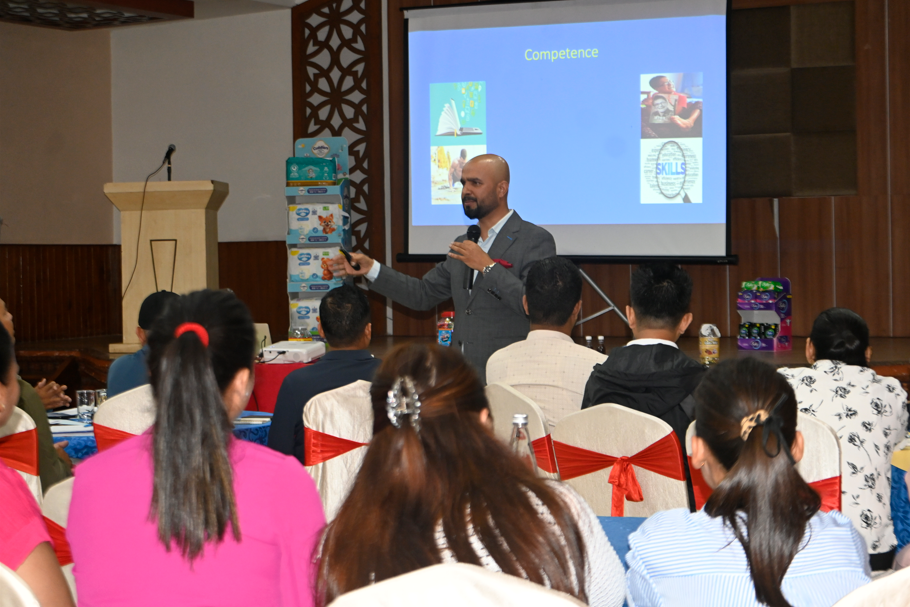
Diwakar Rijal, Sales Trainer in Nepal, helps organizations develop sales mindset, objection handling, consultative selling, and execution-driven sales performance through practical corporate sales training programs.
Book a sales training consultation today and help your team sell with more confidence, clarity, and consistency.
FAQ
What is the inner game of selling?
The inner game of selling refers to the mindset, confidence, belief system, emotional control, and self-image that influence a salesperson’s performance.
Why is mindset important in sales?
Mindset affects how a salesperson communicates, handles rejection, asks questions, presents value, and closes deals. A strong mindset creates better sales behavior.
Can sales confidence be developed?
Yes. Sales confidence can be developed through product knowledge, customer understanding, practice, preparation, and repeated experience.
Why do salespeople fear rejection?
Salespeople fear rejection because they often take customer refusal personally. Professional salespeople treat rejection as feedback and use it to improve.
How can sales training help a sales team?
Sales training helps teams improve confidence, communication, objection handling, customer understanding, follow-up discipline, and closing performance.