When revenue slows, conversion falls, or targets are missed, the immediate response is often “we need sales training.” That may be correct, but it is not always the real diagnosis. A sales training needs assessment helps leaders separate a genuine skill problem from issues involving lead quality, product fit, pricing, territory design, manager coaching, incentives, stock availability, or sales process discipline.
The purpose is simple: identify the specific capability gaps that are limiting results, then decide whether training, coaching, process redesign, or another business action is needed. For SMEs, B2B teams, distributors, and field sales teams in Nepal, this avoids spending on generic workshops that feel motivating but do not improve day-to-day execution.
What is a sales training needs assessment?
A sales training needs assessment is a structured review of the knowledge, behaviours, tools, and working conditions that affect sales results. It compares the performance a business needs with the performance the team is currently producing.
It should identify the weak business result, the sales stage where performance breaks down, the root cause, and the most suitable intervention.
A useful assessment is not a questionnaire alone. It combines performance data, manager interviews, customer feedback, sales-call observation, role plays, pipeline review, and a sales skills assessment. The outcome is a prioritized diagnosis rather than a long list of training topics.
Why sales teams underperform: training is only one possible answer
Sales team underperformance can look similar on the surface. Two teams may both miss monthly targets, but the causes can be very different.
One team may have enough leads but fail to qualify decision makers. Another may have capable people but weak distributor coverage, unclear pricing authority, delayed product delivery, or an incentive plan that rewards the wrong behavior. A third may lack manager coaching, so new salespeople repeat the same mistakes without feedback.
This is why a sales team performance gap should be treated as a business diagnosis, not a personality judgement. Start with evidence. Do not assume low effort, low motivation, or low capability before reviewing the sales environment.
Common symptoms and what to test before deciding on training
| Business signal | Possible underlying issue | Evidence to review | Likely response |
|---|---|---|---|
| Plenty of leads but few meetings | Weak prospecting message, poor targeting, slow first response | Lead source, response time, call recordings, outreach samples | Prospecting practice, segmentation, lead-routing fixes |
| Meetings happen but proposals do not progress | Weak discovery, unclear value, no stakeholder mapping | Discovery notes, proposal-to-next-step rate, lost-deal reasons | Consultative selling and account-planning coaching |
| Prospects ask for discounts early | Poor value communication, weak negotiation, non-competitive pricing | Discount pattern, competitor context, deal margins | Negotiation practice or pricing review |
| Field visits are high but orders are flat | Low-quality visits, territory design, stock or service issues | Visit-to-order ratio, route plan, availability data | Route redesign, retailer execution coaching, supply review |
| Pipeline looks large but forecast fails | Poor qualification, outdated CRM, manager review gaps | Stage ageing, close-date changes, win/loss review | Qualification rules and manager coaching |
| New hires take too long to contribute | Unclear onboarding, missing product knowledge, no field practice | Time-to-first-sale, onboarding checklist, ride-alongs | Structured onboarding and practice-led coaching |
| A few people perform well; most do not | Best practice is not being transferred; process is inconsistent | Top-performer interviews, workflow comparison, role plays | Sales playbook, peer practice, manager-led reinforcement |
| Customers complain about follow-up | Workload, poor reminders, unclear ownership, weak habits | Follow-up time, CRM tasks, complaint themes | Process redesign plus follow-up discipline |
How to conduct a sales training needs assessment in Nepal
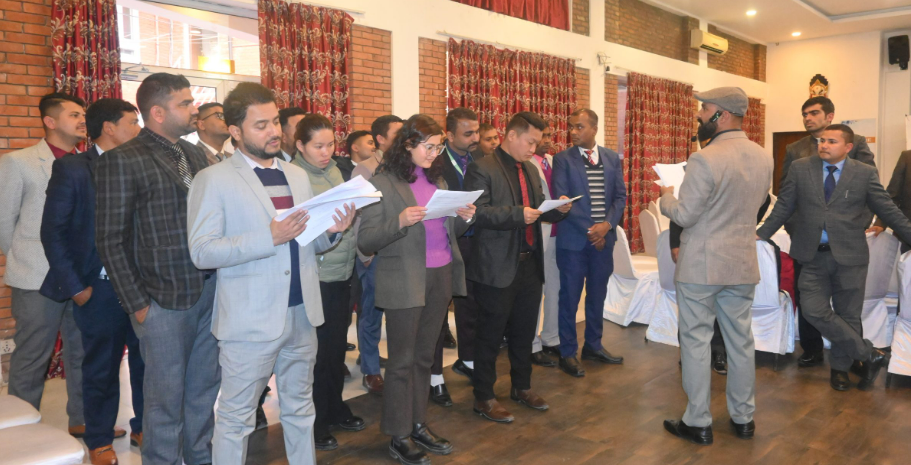
A strong sales training needs assessment in Nepal follows the sales journey from business goal to field behaviour. The process below works for corporate teams in Kathmandu and Lalitpur, nationwide distributor networks, B2B account teams, and customer facing field sales teams.
1. Define the business outcome before listing training topics
Begin with the outcome that leaders want to improve. Be precise.
Instead of “the team needs confidence,” define a measurable need such as:
- Increase qualified meetings from existing lead flow.
- Improve conversion from proposal to order.
- Reduce unproductive field visits.
- Improve distributor activation and retailer productivity.
- Increase cross-selling in existing accounts.
- Shorten the time it takes a new salesperson to reach a defined activity and conversion standard.
Then write the current performance, target performance, time frame, and business impact. This creates a clear assessment question.
Example: A B2B team may need to improve proposal-to-close conversion from 18% to 28% within two quarters. The assessment should explore discovery quality, value communication, stakeholder access, proposal quality, follow-up cadence, pricing flexibility, and manager deal coaching. It should not begin with a pre-selected “closing skills” workshop.
2. Map the sales process and locate the leakage point
Most sales teams do not lose performance everywhere. They lose it at specific stages.
Map the current journey: lead generation, first contact, qualification, needs discovery, solution presentation, proposal, negotiation, close, onboarding, and account growth. For distributor or FMCG-style field teams, include outlet coverage, productive calls, availability, merchandising, order value, and repeat order quality.
For each stage, calculate a basic conversion rate:
Stage conversion rate = number moving to the next stage ÷ number entering the stage × 100
Review three to six months of data where possible. Compare individuals, territories, channels, products, and customer segments. A large difference between people doing the same job often reveals where deeper observation is required.
Do not compare a newly assigned territory with a mature territory without adjusting for potential. The goal is a fair diagnosis, not a ranking exercise.
3. Observe real selling behaviour, not only self-reported confidence
Self-assessments are useful, but they are not enough. Salespeople may rate themselves highly in negotiation or discovery while their actual calls show a different pattern.
Use at least two of the following:
- Listen to recorded calls or review meeting notes.
- Join a field visit or customer meeting as an observer.
- Run short role plays based on real objections.
- Ask managers to score observable behaviours with examples.
- Review emails, messages, proposals, CRM notes, and follow-up quality.
- Interview a small sample of customers, dealers, or channel partners.
Look for behaviour, not vague impressions. “The salesperson did not ask about decision criteria before presenting the product” is useful evidence. “The salesperson lacks confidence” is too broad to design a learning intervention.
4. Run a practical sales capability assessment
A sales capability assessment measures the skills and knowledge required for the role. It should reflect the team’s actual sales model rather than a generic competency list.
For a complex B2B team, the assessment may cover account research, discovery questions, stakeholder mapping, value communication, proposal strategy, negotiation, and pipeline management. For field sales, it may emphasize territory planning, productive calls, outlet engagement, distributor coordination, objection handling, and reporting discipline.
Use a 1–5 behaviour scale, where 1 means “not demonstrated” and 5 means “consistently demonstrated in realistic situations.”
| Capability area | Required level | Current average | Gap | Evidence source |
|---|---|---|---|---|
| Lead qualification | 4.0 | 2.6 | 1.4 | CRM review and role play |
| Needs discovery | 4.0 | 2.4 | 1.6 | Call observation |
| Value communication | 4.0 | 2.8 | 1.2 | Proposal review |
| Objection handling | 3.5 | 2.5 | 1.0 | Role play |
| Negotiation | 3.5 | 2.9 | 0.6 | Deal review |
| Follow-up discipline | 4.0 | 2.2 | 1.8 | CRM and customer feedback |
| Manager coaching | 4.0 | 2.3 | 1.7 | One-to-one meeting audit |
This example does not prove that every gap needs classroom training. It shows where to investigate and prioritize. The largest gap also may not be the first priority; consider its impact on revenue, customer experience, risk, and how quickly it can improve.
5. Separate skill gaps from non-training barriers
Before recommending a sales training in Nepal, test whether the problem is within the salesperson’s control and whether skill development is the most appropriate response.
Training is appropriate when people do not know what to do, cannot yet do it to the required standard, or have not had enough guided practice and feedback. Training alone is unlikely to solve issues such as poor product availability, uncompetitive pricing, unclear territory ownership, insufficient leads, delayed approvals, or unsuitable incentives.
Use this five-part root-cause check:
- Knowledge: Do people understand the product, customer, process, and standard?
- Skill: Can they perform the behaviour during a realistic call or field visit?
- Will: Do incentives, confidence, workload, and perceived fairness support the behaviour?
- System: Are tools, pricing, stock, CRM, approvals, and sales process helping or blocking execution?
- Leadership: Are managers setting expectations, reviewing evidence, coaching, and holding follow-up conversations?
A useful rule is this: do not train a system problem, and do not redesign a process when the core issue is a skill gap.
6. Prioritize the gaps that matter most
A sales team can have ten development needs, but trying to solve all ten at once creates little behaviour change. Choose two or three priorities based on impact and evidence.
Score each gap from 1 to 5 for:
- Revenue or margin impact
- Frequency in the sales process
- Importance to the customer experience
- Size of the current gap
- Ease of improvement within the next 90 days
Add the scores. The highest priorities should become the focus of the sales performance improvement plan.
For example, a team with weak follow-up, poor needs discovery, and unclear pricing authority may need a mixed response: sales-call practice and manager coaching for the first two issues, plus leadership action on pricing authority. Treating all three as “sales skills” would produce an incomplete solution.
What should a sales skills assessment include?
The right sales skills assessment changes with the sales role. However, most corporate and B2B teams benefit from evaluating these capability areas:
- Customer and market understanding
- Prospecting and first-contact quality
- Qualification and opportunity selection
- Discovery, listening, and questioning
- Value communication and solution positioning
- Objection handling and negotiation
- Closing and next-step commitment
- Follow-up and pipeline discipline
- Account management and cross-selling
- CRM, reporting, and sales planning
- Emotional control, resilience, and professional communication
- Manager coaching and performance conversations
Each item should have a behavioural definition. For instance, “good discovery” should mean the salesperson identifies business goals, current challenges, decision criteria, stakeholders, budget range when appropriate, decision timeline, and a mutually agreed next step. Clear definitions make scoring more reliable and training more specific.
Local realities to include in a Nepal focused assessment
A local assessment should reflect the real selling environment. A corporate team in Kathmandu may face multiple decision makers, procurement requirements, relationship-led introductions, and long approval cycles. A field team supporting distributors outside the Valley may face travel time, seasonal demand, inventory gaps, local competition, and uneven reporting.
For SMEs, founder approval for price changes, credit, or large proposals can slow closing. That is a decision rights issue, not automatically a closing skills issue. When distributor activation is weak, test availability, margins, onboarding, relationship quality, and field support before recommending training.
Turn the diagnosis into a 90 day sales performance improvement plan
An assessment only creates value when it changes what leaders and salespeople do next. A practical plan should include capability building, manager reinforcement, system fixes, and measurement.
| Time period | Priority action | Owner | Evidence of progress |
|---|---|---|---|
| Days 1–15 | Confirm baseline metrics, role expectations, and top two performance gaps | Sales head and manager | Scorecard, pipeline review, call observation notes |
| Days 16–30 | Deliver focused practice on the priority skills using real cases | Trainer and managers | Role-play scores, action commitments |
| Days 31–60 | Managers conduct weekly deal reviews and field coaching | Sales managers | Coaching logs, improved activity quality |
| Days 61–90 | Review conversion, pipeline quality, customer feedback, and behaviour adoption | Sales head and leadership | Before/after dashboard, improvement decisions |
Avoid measuring success only through attendance, satisfaction scores, or post-training knowledge tests. Those matter, but business leaders also need to see whether the expected behaviours are appearing in calls, meetings, pipeline reviews, and customer follow-up.
A well-designed corporate sales training Nepal program should therefore include role-specific practice, manager coaching guides, field application tasks, and a 30- to 90-day review. For ongoing execution support, connect the plan to your organization’s sales process, CRM rhythm, and manager one-to-ones.
Common mistakes that weaken a sales training needs assessment
Do not choose negotiation, presentation, or motivation as the topic before reviewing evidence. Do not use target achievement alone; revenue does not reveal whether the cause is lead quality, skills, pricing, product availability, or management.
Managers must reinforce new behaviour through feedback, deal reviews, and coaching. Finally, capture a baseline before acting and avoid treating every weak performer the same way. The intervention should match the cause.
When should you bring in external sales training support?
External support is useful when a team needs an objective diagnosis, realistic practice, or a manager-coaching system that internal leaders cannot build alone. It is particularly relevant when a business is scaling beyond founder-led selling, launching a new product, building B2B capability, or standardizing execution across territories and distributors.
The right partner should begin with assessment and customization, not a fixed agenda. For structured support, explore Corporate Sales Training, Sales Leadership Training, Sales Execution Systems, and Manager Coaching through Diwakar Rijal’s services page.
Frequently asked questions
What is a sales training needs assessment?
A sales training needs assessment identifies the gap between the sales performance a business needs and the skills, behaviours, systems, or leadership practices currently in place. It determines whether training is the right solution and what should be prioritized.
How do you identify a sales team performance gap?
Map each stage of the sales process, review conversion and pipeline data, observe real sales conversations, assess role-specific skills, and test for system or management barriers. The gap is the difference between the required standard and current evidence-based performance.
What should a sales skills assessment include?
It should assess the skills required for the role, such as prospecting, qualification, discovery, value communication, objection handling, negotiation, follow-up, account management, CRM discipline, and manager coaching. Use behaviour-based scoring rather than opinion alone.
How often should companies in Nepal conduct a sales capability assessment?
Conduct a light review quarterly and a deeper assessment at least annually, or when there is a major change such as a new product, new territory, high attrition, weak conversion, or a shift in customer behaviour. High-growth teams may need more frequent manager-led reviews.
Can sales training fix sales team underperformance?
Sales training can improve underperformance when the root cause is a knowledge, skill, or practice gap. It will not fix problems caused mainly by weak leads, pricing, supply, territory design, unclear roles, missing tools, or poor management follow-through.
Final takeaway
Sales underperformance is rarely solved by motivation alone. A disciplined assessment shows where the sales process is leaking, which behaviours need to change, and which barriers leaders must remove.
Use data to find the stage, observation to understand the behaviour, and root-cause analysis to choose the right intervention. That is how a sales training needs assessment becomes a practical business decision rather than a routine HR activity.
About the author

Diwakar Rijal is a sales trainer, performance catalyst, motivational speaker, and marketing consultant in Nepal, focused on practical capability development, structured selling, leadership coaching, and field application.