
Consultative selling techniques help salespeople close more effectively by replacing premature pitching with structured discovery. Instead of beginning with product features, the salesperson asks questions that uncover the customer’s current situation, priorities, difficulties, desired outcomes, decision criteria and buying process.
The purpose is not to ask all possible questions. It is to ask the right question at the right stage, listen carefully and connect the recommendation to what the customer has actually said.
This approach is particularly useful for B2B teams, insurance advisors, corporate relationship managers, professional-service providers and salespeople handling complex or high-consideration purchases. This article explains the consultative sales process and provides 15 practical questions that teams can adapt to their industry.
What Is Consultative Selling?
Consultative selling is a customer-focused sales approach in which a salesperson first understands the customer’s problem, context and desired result before recommending a product or service. The salesperson behaves more like a problem-solving advisor than a product presenter.
Salesforce describes consultative selling as an approach based on building trust, identifying the root cause of a customer’s problem and developing a plan to address it.
The central sequence is:
Understand first → diagnose carefully → recommend selectively → agree on action.
This does not mean the salesperson avoids closing. It means the close is based on a relevant business case rather than pressure.
A consultative seller tries to understand:
- What is happening now?
- Why is it a problem or opportunity?
- Who is affected?
- What happens if nothing changes?
- What result does the buyer want?
- How will the buyer evaluate possible solutions?
- Who will influence or approve the decision?
- What should happen next?
Customer-oriented selling has long been studied as a distinct sales behaviour. Research by Saxe and Weitz connected customer-oriented selling with the salesperson’s ability to help customers and with the quality of the customer–salesperson relationship.
Why Do Better Questions Lead to Better Sales Conversations?
Better questions improve sales conversations because they give the salesperson information that a standard presentation cannot provide.
Two companies may request the same product but want it for very different reasons. One may be trying to reduce cost. Another may need reliability. A third may be worried about employee adoption, delivery time, regulatory requirements or service support.
A generic pitch treats all three buyers the same. A consultative conversation discovers what is different.
Effective sales questions help a salesperson:
- Understand the customer’s language
- Separate symptoms from root problems
- Recognize priorities and constraints
- Avoid recommending an unsuitable option
- Identify the people involved in the decision
- Connect benefits to measurable or observable outcomes
- Agree on a realistic next step
Consultative selling also requires adaptation. Spiro and Weitz defined adaptive selling as changing sales behaviour during or across interactions according to the perceived nature of the sales situation.
In practical terms, a salesperson should not use exactly the same script, pace, vocabulary or presentation for every buyer. The questions can provide structure, but the customer’s answers should shape the conversation.
Before detailed discovery begins, the salesperson must also create enough comfort for the customer to speak openly. The website’s guide to building customer trust before the pitch explains why broad, contextual openings should usually come before narrow qualification questions.
What Is the Consultative Sales Process?
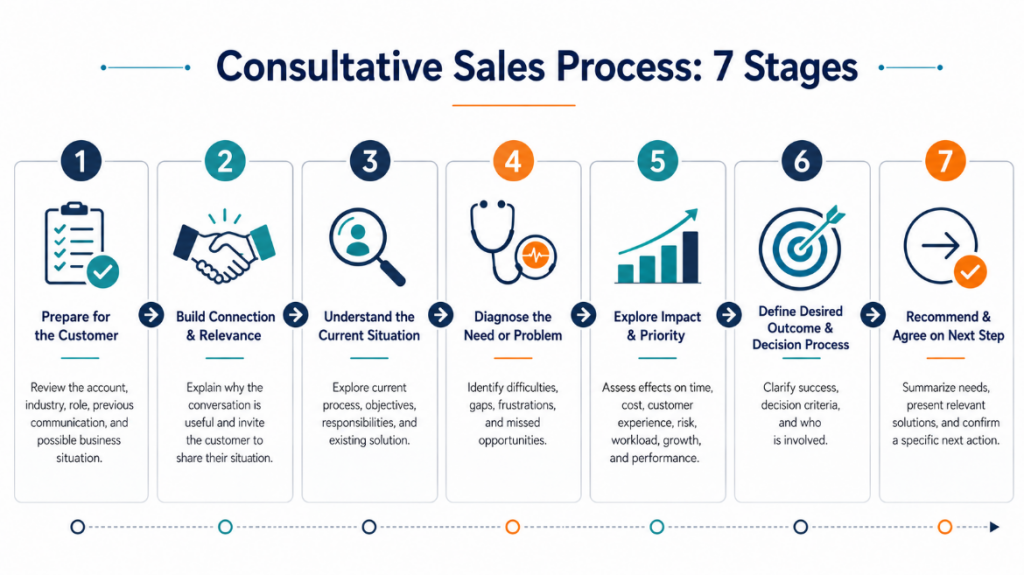
A useful consultative sales process has seven stages.
1. Prepare for the customer
Review the account, industry, role, previous communication and possible business situation before the meeting.
Preparation should create informed curiosity, not assumptions. Write down what you know, what you only suspect and what you need to verify.
2. Build connection and establish relevance
Explain why the conversation may be useful and invite the customer to share their situation.
A simple opening may be:
“I would like to understand how you are handling this currently, what you would like to improve and whether there is a useful fit. Would that be okay?”
This gives the customer a clear agenda without creating pressure.
3. Understand the current situation
Explore the customer’s present process, objectives, responsibilities and existing solution.
Situation questions are useful, but they should not occupy the entire conversation. Information that can be researched before the meeting should not be collected through unnecessary questions.
4. Diagnose the need or problem
Move from facts to difficulties, gaps, frustrations and missed opportunities.
At this stage, do not treat the first problem mentioned as the complete diagnosis. Ask what is causing it, where it appears and how often it occurs.
5. Explore impact and priority
Help the buyer examine what the issue affects: time, cost, customer experience, risk, workload, growth, service quality or team performance.
This stage separates a minor inconvenience from an issue worth solving.
The SPIN framework organizes questions into Situation, Problem, Implication and Need-Payoff categories. Implication questions explore the consequences of a problem, while need-payoff questions help the customer describe the value of improvement.
6. Define the desired outcome and decision process
Clarify what success would look like, which criteria matter and who needs to participate in the decision.
Without this stage, a salesperson may present a relevant solution to the wrong stakeholder or use the wrong value argument.
7. Recommend and agree on the next step
Summarize what you heard before presenting anything:
“You mentioned that the current process is creating delays, the sales managers lack visibility and any new system must be simple for the field team. Have I understood the main priorities correctly?”
Only then should the salesperson connect selected capabilities to the customer’s stated needs.
End with a specific, mutually agreed action rather than a vague promise to “stay in touch.”
15 Consultative Selling Questions That Help Sales Teams Close Better
These questions are organized into five stages. Salespeople should not fire all 15 questions at every customer. Choose the questions that fit the situation and use follow-up questions based on the customer’s answers.
Stage 1: Understand the Customer’s Context
1. “What prompted you to explore this now?”
This question uncovers the trigger behind the conversation.
The trigger may be a new target, a customer complaint, an operational problem, a management decision, a competitor’s action, a policy change or an upcoming expansion.
Listen for:
- Why the issue has become relevant now
- Whether the customer is actively seeking change
- Whether the enquiry is exploratory or urgent
- Who initiated the search
A useful follow-up is:
“What changed compared with three or six months ago?”
This prevents the salesperson from treating every enquiry as equally urgent.
2. “What are you trying to improve or achieve?”
This question moves the discussion toward the customer’s desired business result.
A customer may initially ask for a product, workshop, policy, system or quotation. That request does not always reveal the real outcome they want.
For example, a company asking about sales training may actually want to improve discovery, strengthen follow-up, reduce discounting or standardize the team’s sales process.
Listen for:
- The result the customer values
- How clearly the objective is defined
- Whether the request is connected to a wider business goal
- The customer’s preferred language for describing success
Avoid replacing the customer’s objective with your own interpretation too quickly.
3. “How are you handling this at present?”
This question reveals the status quo.
It helps the salesperson understand the current process, tools, provider, internal method or workaround. It may also reveal why the customer has not changed already.
Useful follow-ups include:
- “What is working well in the current approach?”
- “Where does the current approach become difficult?”
- “Who is responsible for managing it?”
Respect what already works. Consultative selling is not about proving that everything the customer currently does is wrong.
Stage 2: Diagnose the Real Need
4. “Where does the current process create the most difficulty?”
This question moves from a broad situation to a specific problem.
The phrase “most difficulty” encourages prioritization. Without it, the salesperson may receive a long list of minor complaints without understanding which one matters most.
Listen for problems involving:
- Time
- Accuracy
- Customer experience
- Team consistency
- Cost
- Risk
- Communication
- Delayed decisions
- Lost revenue
- Employee workload
A practical follow-up is:
“Can you give me a recent example?”
Examples help the salesperson distinguish a real recurring problem from a general opinion.
5. “What do you believe is causing that difficulty?”
This question explores the customer’s view of the root cause.
The customer may identify lack of skills, poor coordination, weak tools, unclear roles, insufficient follow-up, price pressure, low trust or slow approvals.
Do not assume the customer’s first explanation is complete. Use a neutral follow-up:
“What else may be contributing to it?”
For instance, low closing rates may come from weak questioning, but they may also come from poor lead quality, unsuitable pricing or delayed proposals. A training solution should not be prescribed before the cause is understood.
Organizations can use a formal sales training needs assessment when they need to separate genuine skill gaps from process, leadership or market problems.
6. “What have you already tried, and what happened?”
This question prevents the salesperson from recommending an approach that has already failed.
It also reveals:
- The customer’s level of commitment
- Previous suppliers or internal initiatives
- Resistance inside the organization
- Implementation barriers
- What the customer liked or disliked
- Expectations created by previous experiences
A previous solution may have failed because it was wrong, but it may also have failed because adoption, leadership support or follow-up was weak.
Ask:
“What would need to be different this time?”
That answer can become an important decision criterion later.
Stage 3: Explore the Impact
7. “Who or what is most affected by this problem?”
This question broadens the conversation beyond the immediate contact.
The problem may affect:
- Customers
- Frontline employees
- Sales managers
- Finance
- Operations
- Distributors
- Senior management
- Profitability
- Service quality
- Brand reputation
The answer can reveal hidden stakeholders who should be involved in the decision.
In a hypothetical pharmaceutical-sales example, inconsistent product communication may affect medical representatives, area managers, doctors and the company’s market positioning. In an insurance example, weak needs analysis may affect the agent, the customer’s trust and the suitability of the recommendation.
8. “What does this problem cost you in time, revenue, effort or risk?”
This is an implication question. It helps the customer examine the business effect of maintaining the status quo.
Not every impact has to be converted into money. The effect may involve:
- Management time
- Rework
- Delayed service
- Lost opportunities
- Discounting
- Complaints
- Employee frustration
- Compliance exposure
- Forecast uncertainty
- Slow customer decisions
Do not invent figures for the buyer. Ask for evidence they can reasonably estimate.
Useful follow-ups include:
- “How frequently does that happen?”
- “What does your team have to do when it happens?”
- “Does it affect other departments or customers?”
9. “What is likely to happen if nothing changes?”
This question tests priority without creating artificial fear.
Possible answers include:
- The problem will remain manageable
- The company will miss an opportunity
- Costs or delays will continue
- The team will struggle to meet a target
- Customer complaints may increase
- A planned expansion may become difficult
- Management may choose another initiative instead
The answer may also show that the problem is not urgent. That is useful information.
An ethical consultative seller should be willing to conclude that the customer does not need immediate action.
Stage 4: Define the Desired Outcome and Buying Criteria
10. “What would a successful outcome look like?”
This is one of the most important needs-based selling questions because it moves the customer from dissatisfaction to a clear definition of improvement.
Success may mean:
- A more consistent sales conversation
- Faster response time
- Better customer retention
- Fewer errors
- Higher-quality proposals
- Stronger manager coaching
- Improved product adoption
- A simpler process
- Better reporting visibility
Ask how the customer would recognize the result:
“What would your team be doing differently if this worked?”
This creates a behavioural definition of success rather than a vague expectation.
11. “Which factors will matter most when comparing possible solutions?”
This question identifies the customer’s decision criteria before the proposal is prepared.
Criteria may include:
- Price
- Quality
- Suitability
- Ease of implementation
- Trainer or provider experience
- Customization
- Service support
- Delivery schedule
- Reliability
- User adoption
- Risk
- Evidence of practical application
The salesperson can then present around the criteria the buyer has identified instead of overloading the buyer with every possible feature.
If the customer says price is the only factor, explore respectfully:
“Besides price, what would make one option safer or more suitable than another?”
Do not use this question to avoid legitimate price discussion. Price remains an important decision criterion.
12. “What would make you confident that this is the right choice?”
This question uncovers the proof the customer needs.
Confidence may require:
- A demonstration
- References
- A pilot
- Technical documentation
- A customized plan
- Clear implementation steps
- Management approval
- A comparison
- Answers to risk-related concerns
- An opportunity to involve end users
The answer helps the salesperson reduce uncertainty without relying on pressure or exaggerated promises.
Is your team presenting solutions before understanding the customer’s real problem? Explore Diwakar Rijal’s consultative selling and sales strategy training to strengthen discovery, questioning, stakeholder mapping and value communication.
Stage 5: Understand the Decision and Agree on Action
13. “Who else should be involved in evaluating or approving this?”
This is a respectful way to identify stakeholders without asking abruptly, “Are you the decision-maker?”
Complex B2B decisions often involve a buying committee or several people with different roles, including users, influencers, financial approvers and final decision-makers. LinkedIn’s buying-committee guidance similarly emphasizes identifying and engaging the people who shape a B2B purchase.
Useful follow-ups include:
- “Who will use the solution most closely?”
- “Who will evaluate the financial side?”
- “Whose support will be important during implementation?”
- “What concerns might the final approver raise?”
For a more detailed stakeholder framework, review the guide on identifying and selling to decision makers.
14. “What timing are you working toward, and what could affect it?”
This question is better than simply asking, “When will you buy?”
It reveals:
- Desired implementation date
- Budget cycle
- Internal meetings
- Procurement requirements
- Seasonal factors
- Contract expiry
- Management availability
- Dependencies on another project
A customer may have a preferred date but no approved process. Understanding both the target and the obstacles helps the salesperson build a realistic follow-up plan.
15. “What would be the most useful next step from here?”
This question creates a collaborative close.
The next step may be:
- A second meeting
- A demonstration
- A site assessment
- A proposal
- A pilot
- A discussion with management
- A technical review
- A needs assessment
- A final commercial conversation
- No further action
A strong next step should include:
- The action
- The person responsible
- The timing
- The purpose
- What information is needed beforehand
For example:
“We will prepare a customized workshop outline covering discovery, value communication and manager reinforcement. You will review it with the sales head, and we will discuss feedback next Wednesday.”
That is clearer than “I will send something and follow up later.”
Consultative-Selling Question Summary
| Sales stage | Primary purpose | Example question |
|---|---|---|
| Context | Understand why the conversation is happening | What prompted you to explore this now? |
| Objective | Identify the desired result | What are you trying to improve? |
| Current approach | Understand the status quo | How are you handling this at present? |
| Problem | Locate the main difficulty | Where does the current process create the most difficulty? |
| Cause | Explore the root issue | What do you believe is causing it? |
| Previous action | Avoid repeating failed solutions | What have you already tried? |
| Stakeholder impact | Identify who is affected | Who or what is most affected? |
| Business impact | Quantify importance | What does this cost in time, effort, revenue or risk? |
| Consequence | Test urgency | What happens if nothing changes? |
| Desired outcome | Define success | What would a successful outcome look like? |
| Criteria | Understand how options will be compared | Which factors will matter most? |
| Confidence | Identify required proof | What would make you confident? |
| Decision roles | Map stakeholders | Who else should be involved? |
| Timing | Understand the decision schedule | What timing are you working toward? |
| Next step | Advance the opportunity appropriately | What would be the most useful next step? |
The sequence matters more than memorizing the wording. A customer will usually discuss buying criteria more openly after the salesperson understands the problem and its impact.
Consultative Selling vs Product Selling vs Solution Selling
Consultative selling, needs-based selling and solution selling overlap, but they are not identical.
| Approach | Starting point | Main salesperson behaviour | Best suited to | Main risk |
|---|---|---|---|---|
| Product selling | Product features and availability | Explains what the product does | Simple or familiar purchases | Irrelevant feature dumping |
| Needs-based selling | Expressed customer need | Matches an offer to the stated need | Insurance, retail and service recommendations | Treating the first stated need as the full diagnosis |
| Solution selling | Defined business problem | Combines capabilities into a solution | Complex B2B problems | Presuming the buyer already understands the problem |
| Consultative selling | Customer context, problem and decision process | Diagnoses, advises, adapts and guides | Complex, high-consideration or relationship-based sales | Over-questioning without offering useful insight |
Salesforce defines solution selling as an approach that focuses on customer needs and pain points and recommends a solution for them.
Consultative selling goes slightly further by emphasizing the quality of diagnosis, the customer’s decision process, adaptive communication and the seller’s responsibility to recommend only when there is a meaningful fit.
These approaches should not become rigid labels. A skilled salesperson may use product knowledge, needs analysis and solution design within one consultative conversation.
How Do Consultative Questions Help When Selling to Decision Makers?
Consultative questions help salespeople identify what each stakeholder cares about.
A user may prioritize convenience. A sales manager may prioritize adoption. Finance may prioritize cost and risk. The business owner may prioritize growth, reliability or return on investment.
Do not repeat one generic pitch to everyone. Build a consistent business case while adapting the emphasis.
Questions for different roles may include:
For users:
“How would this affect your day-to-day work?”
For managers:
“What would your team need in order to adopt this successfully?”
For finance:
“What financial or risk criteria must the proposal address?”
For a senior approver:
“What result would make this initiative worthwhile for the organization?”
For procurement:
“What documentation and evaluation steps are required?”
Stakeholder mapping is not an attempt to bypass the original contact. Respect that person and ask for their guidance:
“You understand the organization and process better than we do. Who would be useful to include so that the recommendation addresses everyone’s concerns?”
This positions the contact as a partner rather than an obstacle.
What Should a Salesperson Do After Asking a Question?
A consultative question creates value only when the salesperson listens and responds effectively.
Use the Listen–Clarify–Confirm–Connect sequence.
Listen
Allow the customer to finish. Do not use the answer as a pause while waiting to deliver a prepared pitch.
Pay attention to:
- Repeated words
- Emotional emphasis
- Uncertainty
- Specific examples
- People mentioned
- Measures of success
- Concerns the buyer avoids or minimizes
Clarify
Ask a follow-up when the answer is broad.
Customer:
“Our team is not consistent.”
Salesperson:
“When you say inconsistent, is the main difference in prospecting, needs discovery, presentation or follow-up?”
Clarification turns vague language into useful information.
Confirm
Summarize what you understood.
“So the leads are sufficient, but the team is moving to proposals before confirming the decision criteria. Is that accurate?”
Confirmation reduces misunderstanding and demonstrates active listening.
Connect
Connect the recommendation only to the needs that have been established.
“Because the issue appears in discovery and stakeholder mapping, the training should prioritize those two behaviours rather than providing a broad motivational program.”
The website’s consultative selling and sales strategy training includes discovery frameworks, pain-point identification and strategic account planning. Organizations can use that service when these behaviours need structured practice and coaching.
Common Consultative-Selling Mistakes
Asking too many questions without explaining why
A long sequence of questions can feel like an interrogation.
Set context:
“I would like to understand the present process, the effect of the problem and the criteria that will matter in your decision. Then I can tell you honestly whether we can help.”
Pitching after the first problem appears
The first problem may be a symptom.
When a customer says, “Our closing is weak,” do not immediately present closing training. Explore discovery quality, lead qualification, stakeholder access, proposal relevance, follow-up and pricing.
Asking questions that could have been researched
Do not waste the customer’s time asking for basic information available on the company’s website, public profile or previous communication.
Use meeting time for interpretation and insight.
Using leading questions
A leading question attempts to force the customer toward the seller’s conclusion:
“Wouldn’t you agree that your current provider is costing you money?”
A neutral alternative is:
“How would you evaluate the cost and performance of the current approach?”
Ignoring positive aspects of the current solution
Customers may resist when the salesperson criticizes everything they currently use.
Ask what works well. A credible recommendation may preserve successful elements while changing only what is necessary.
Treating every expressed need as a buying commitment
A buyer can have a genuine problem and still lack budget, authority, timing or internal agreement.
Discovery should examine fit and readiness, not assume them.
Asking about budget too early
Budget matters, but an abrupt budget question can reduce openness.
First understand the outcome and scope. Then ask:
“Has a budget range been discussed for addressing this?”
Failing to document the customer’s wording
CRM notes such as “interested, send proposal” are not adequate.
Capture:
- Current situation
- Main problem
- Business impact
- Desired outcome
- Decision criteria
- Stakeholders
- Concerns
- Timing
- Agreed next step
Good notes support better proposals and manager coaching.
Ending without a clear next step
A positive meeting is not the same as sales progress.
Confirm what each party will do and by when.
How Can Sales Managers Train Teams in Consultative Selling?
Consultative selling improves through observation, practice and feedback—not through a question list alone.
1. Define the expected discovery standard
Managers should clarify what a salesperson must understand before preparing a proposal.
For a B2B opportunity, the minimum may include:
- Customer objective
- Current process
- Main challenge
- Business impact
- Desired result
- Decision criteria
- Stakeholders
- Timing
- Agreed next step
2. Review real opportunities
During a deal review, do not ask only, “When will it close?”
Ask:
- What problem is the customer solving?
- How do you know it is a priority?
- What happens if the customer does nothing?
- Who is affected?
- Who will approve the decision?
- What criteria will they use?
- What evidence do they need?
- What is the agreed next action?
When the salesperson cannot answer, the manager has identified a discovery gap.
3. Practise one stage at a time
Do not train all 15 questions in one role-play.
One session may focus on problem diagnosis. Another may focus on impact questions. A third may focus on stakeholder mapping.
Focused repetition develops confidence and natural delivery.
4. Score observable behaviour
A simple discovery scorecard can rate whether the salesperson:
- Created a clear agenda
- Used open-ended questions
- Asked relevant follow-ups
- Explored impact
- Identified decision criteria
- Confirmed understanding
- Avoided premature pitching
- Agreed on a next step
5. Coach from recordings and notes
Review calls, meeting summaries, proposals and CRM notes.
Compare the claims in the proposal with the needs documented during discovery. A proposal that discusses features the customer never identified as important usually signals weak discovery or weak solution alignment.
6. Build industry-specific question banks
A corporate software team, insurance agency, pharmaceutical team and education-admissions team should not rely on identical examples.
The underlying stages remain consistent, but the language should reflect the customer’s real decisions.
The website outlines different sales challenges across insurance, healthcare, hospitality, education, pharmaceutical and corporate sales environments. Teams can review these industry-specific sales contexts when adapting their discovery questions.
7. Measure behaviour after training
Training evaluation should extend beyond attendance and participant satisfaction.
Managers can review:
- Percentage of opportunities with complete discovery notes
- Proposals linked to documented needs
- Number of opportunities with identified stakeholders
- Proposal-to-next-step movement
- Reasons deals stall
- Frequency of manager coaching
- Quality of agreed next steps
Organizations unsure where the problem sits should assess current calls, proposals, pipeline records and manager practices before selecting a workshop.
When May Consultative Selling Not Be Necessary?
A full consultative process is not required for every sale.
It may be unnecessary when:
- The purchase is simple and low-risk
- The customer knows the exact item required
- The salesperson has little ability to customize the recommendation
- Speed and convenience matter more than diagnosis
- The transaction is a routine repeat order
Even then, basic customer orientation remains useful. A salesperson can still confirm the requirement, avoid unsuitable recommendations and provide a clear next step.
The goal is not to make every interaction longer. The goal is to make the depth of the conversation appropriate to the complexity and risk of the decision.
Key Takeaways
Consultative selling techniques work by improving diagnosis before recommendation.
Salespeople should:
- Establish context and trust.
- Understand the current situation.
- Identify the real problem and its cause.
- Explore business and stakeholder impact.
- Define the desired outcome.
- Clarify decision criteria and proof requirements.
- Identify everyone involved in the decision.
- Agree on a specific next step.
- Adapt the conversation rather than reading a fixed script.
- Recommend only when there is a relevant fit.
The 15 questions in this guide are not a checklist to recite. They are a framework for thinking, listening and guiding the customer toward a sound decision.
Organizations that want to turn these principles into consistent team behaviour can explore structured sales training in Nepal or discuss a customized program with a corporate sales trainer for B2B teams.
The best next step is to review actual sales calls, proposals and pipeline notes to identify where discovery currently breaks down. From there, the team can practise the questions and behaviours that have the greatest effect on its real opportunities.
Author Bio
Diwakar Rijal is a sales trainer, performance catalyst, motivational speaker and marketing consultant in Nepal. His professional background includes B2B sales, tender processes, account management, sales management, value-based selling, customer-focused sales systems and corporate training. He is also the CEO of BaAma Consultant and provides practical capability-development programs for sales teams and organizational leaders.
FAQs
What is consultative selling?
Consultative selling is a customer-focused approach in which the salesperson understands the customer’s situation, problem, desired outcome and decision process before recommending a solution. The goal is to create relevance and support a sound buying decision rather than beginning with a generic product pitch.
What are the best questions to ask in consultative selling?
The best questions explore why the customer is considering change, what they want to improve, how they currently manage the issue, where difficulties occur, what impact the problem creates, what success looks like, who will influence the decision and what next step would be useful.
What is the difference between consultative selling and solution selling?
Solution selling focuses on matching a solution to a recognized problem. Consultative selling places greater emphasis on diagnosing the problem, exploring its impact, adapting to the customer, understanding the buying process and determining whether the proposed solution is genuinely appropriate.
How many questions should a salesperson ask during discovery?
There is no fixed number. The salesperson should ask enough questions to understand the customer’s objective, current situation, problem, impact, desired outcome, decision criteria, stakeholders and next step. Asking fewer relevant questions is better than mechanically asking a long list.
How can salespeople ask questions without sounding like interrogators?
Explain the purpose of the discussion, begin with broad contextual questions and respond to each answer before asking another question. Use short summaries, relevant follow-ups and natural transitions. Avoid firing several narrow qualification questions in succession.
What is needs-based selling?
Needs-based selling is an approach in which the salesperson identifies a customer’s requirements and recommends an offer that fits them. It becomes more consultative when the salesperson also explores the need’s cause, business impact, priority, stakeholders and decision criteria.
Can consultative selling be used in insurance sales?
Yes. Insurance advisors can use consultative selling to understand a customer’s life stage, responsibilities, protection gaps, financial priorities and concerns before discussing policies. Recommendations should remain suitable, transparent and consistent with applicable regulations and organizational standards.
How does consultative selling help with decision-makers?
It helps the salesperson understand who will use, influence, evaluate, fund and approve the purchase. The salesperson can then address each stakeholder’s priorities while developing one consistent business case for the proposed solution.
Does consultative selling guarantee a higher closing rate?
No sales technique guarantees a sale. Consultative selling can improve relevance, qualification and customer understanding, but results also depend on product fit, pricing, lead quality, competition, implementation capability, timing and the customer’s willingness to change.
How can a sales manager improve the team’s questioning skills?
Managers can review recorded calls, observe meetings, inspect CRM notes, run role-plays and score specific discovery behaviours. Coaching should focus on one skill at a time, such as impact questions, stakeholder identification, active listening or next-step agreement.