
The benefits of hiring a motivational speaker for corporate events include improved employee morale, stronger team alignment, better communication, clearer goal focus, and renewed energy toward performance. For companies in Nepal, a motivational speaker can help employees connect daily work with purpose, especially during annual meetings, sales conferences, leadership retreats, dealer meets, and corporate training programs.
A good motivational talk is not just entertainment. It should help employees think, reflect, and act differently after the event.
This is important because employee engagement remains a global challenge. Gallup reported that only 20% of employees worldwide were engaged at work in 2025, while stress, anger, and sadness stayed above pre-pandemic levels.
For Nepalese companies managing competition, growth pressure, employee turnover, and sales targets, motivation must be connected with practical action.
Why Hire a Motivational Speaker for a Corporate Event?
A company should hire a motivational speaker when it wants to improve employee energy, strengthen teamwork, support change, build leadership mindset, or align people around business goals.
For corporate events in Nepal, a speaker can be useful when employees need:
| Business Need | How a Motivational Speaker Helps |
| Low morale | Rebuilds confidence and energy |
| Weak teamwork | Encourages shared ownership |
| Sales pressure | Improves resilience and execution mindset |
| Change fatigue | Helps employees adapt with clarity |
| Leadership gaps | Reinforces accountability and communication |
| Annual events | Connects celebration with future goals |
The real value comes when the message is relevant to the audience, industry, and business challenge.
Why Corporate Motivation Matters in Nepal
Nepal’s business environment is changing. Companies are competing for customers, talent, and attention. Teams are expected to do more with better communication, faster execution, and stronger service quality.
The World Bank noted in 2025 that Nepal needs to create 6.5 million jobs over the next 30 years to keep pace with its growing working-age population. This highlights the importance of workforce development, skill-building, and better job quality in Nepal’s economy.
Corporate training and motivational speaking are part of that larger people development effort.
A motivational speaker in Nepal for corporate events can help employees understand that performance is not only about targets. It is also about attitude, discipline, learning, customer focus, emotional control, and teamwork.
This is especially relevant for:
- Sales teams
- Banking and finance employees
- Insurance teams
- Pharmaceutical and healthcare teams
- Hospitality teams
- Educational institutions
- Corporate leadership groups
- Dealer and distributor networks
- Startups and growing companies
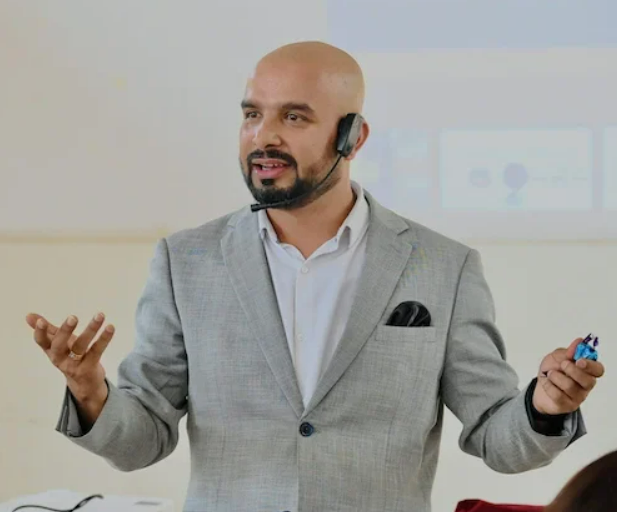
Diwakar Rijal is a motivational speaker, leadership and sales trainer in Nepal with over 20 years of experience, focusing on practical skills, execution frameworks, and sustainable performance improvement rather than temporary excitement.
Key Benefits of Hiring a Motivational Speaker for Corporate Events
The main benefits of hiring a motivational speaker are not limited to one inspiring speech. A strong session can support employee mindset, business alignment, and workplace behavior.
Below are the most important benefits for companies in Nepal.
1. Improves Employee Morale and Energy
Employees often come to corporate events after months of pressure, deadlines, customer complaints, sales targets, or internal challenges.
A motivational speaker can help them pause, reflect, and regain energy.
This does not mean ignoring real workplace problems. It means helping employees see their role with more clarity and confidence.
A well-delivered motivational talk can:
- Recognize employees’ effort
- Reduce emotional fatigue
- Create a sense of belonging
- Encourage positive thinking
- Help people reconnect with company goals
Gallup’s 2026 workplace report states that global employee engagement declined for a second year in 2025 and reached its lowest level since 2020. The report also noted that lower engagement among managers contributed strongly to this decline.
For corporate leaders, this shows why morale is not a soft issue. It affects performance, retention, and team behavior.
2. Builds Team Alignment Around Common Goals
Many companies have clear business goals, but employees may not always feel connected to them.
A motivational speaker helps translate business goals into human language.
For example, instead of only saying “increase sales,” the speaker can help the team understand:
- Why the target matters
- How each role contributes
- What behavior must change
- How teamwork affects results
- Why consistency matters more than short-term excitement
This is useful during annual kick-off meetings, sales conferences, dealer events, leadership retreats, and employee engagement programs.
When people understand the purpose behind the target, they are more likely to take ownership.
3. Encourages Action, Not Just Inspiration
A common problem with motivational talks is that people feel excited for one day and return to old habits the next week.
That is why companies should choose a speaker who connects motivation with action.
Diwakar Rijal describes his approach as “Motivaction,” meaning motivation plus action, especially for industries such as insurance, corporate, pharmaceutical, healthcare, sales, and hospitality.
This practical approach matters.
A useful motivational session should help employees leave with:
| Before the Session | After a Practical Session |
| “I feel stressed.” | “I know what to focus on first.” |
| “Targets are difficult.” | “I need a better daily process.” |
| “Customers reject us.” | “Rejection is part of sales discipline.” |
| “Management does not understand.” | “I can communicate better upward and downward.” |
| “I am just doing my job.” | “My role affects the larger business.” |
In corporate events, motivation should not end with applause. It should lead to better habits.
4. Supports Corporate Training and Skill Development
Motivational speaking and corporate training are different, but they work well together.
A motivational talk builds mindset.
Corporate training builds skills.
Coaching and follow-up build consistency.
For example, a sales team may need motivation to handle rejection. But they also need practical sales training on prospecting, questioning, negotiation, objection handling, and closing.
LinkedIn’s 2025 Workplace Learning Report highlights that learning combined with career development, leadership training, coaching, and internal mobility helps organizations build critical skills for business needs.
The Association for Talent Development also reported that the average organization spent $1,283 per employee on workplace learning in 2023, showing that companies continue to invest in employee development.
For Nepalese companies, this means motivational sessions should ideally be part of a broader learning plan.
5. Improves Communication and Workplace Culture
Many workplace problems are communication problems.
Teams may struggle because employees do not speak openly, managers do not give clear feedback, or departments work in silos.
A good motivational speaker can create a neutral space where employees reflect on communication, ownership, and respect.
The speaker can help teams discuss:
- Listening before reacting
- Taking responsibility instead of blaming
- Communicating clearly with customers
- Supporting colleagues during pressure
- Giving feedback without disrespect
- Managing emotions at work
Corporate culture is built through repeated behavior. A motivational talk cannot change culture alone, but it can start useful conversations.
For example, after a session, leaders can run follow-up discussions with department heads and ask: “What is one behavior we must improve this month?”
That turns inspiration into action.
6. Helps Employees Handle Change and Uncertainty
Companies in Nepal are facing changes in technology, customer expectations, competition, and workplace habits.
Employees may feel uncertain when systems change, leadership changes, sales strategies shift, or new tools are introduced.
A motivational speaker can help employees understand that change is not only a management decision. It is also a mindset challenge.
A strong session can help employees:
- Reduce fear of change
- Understand the reason behind transformation
- Accept learning as part of work
- Stay flexible during uncertainty
- Focus on what they can control
This is especially useful during mergers, restructuring, product launches, branch expansion, CRM implementation, digital transformation, or new sales strategy rollouts.
7. Strengthens Leadership Mindset
Motivational speakers are not only useful for junior employees. They can also support managers and leaders.
Managers often face pressure from both sides. They must meet company expectations while also handling team emotions, performance issues, and customer demands.
Gallup’s workplace data shows that manager engagement declined significantly, with manager engagement falling from 31% in 2022 to 22% in 2025.
This matters because managers influence the daily experience of employees.
A motivational speaker can help managers reflect on:
| Leadership Area | Why It Matters |
| Accountability | Teams follow what leaders practice |
| Communication | Clear direction reduces confusion |
| Emotional control | Calm leaders create stable teams |
| Recognition | Employees need to feel seen |
| Coaching | Managers should develop people, not only assign tasks |
| Execution | Strategy fails without follow-through |
For leadership events, the session should be more mature, practical, and discussion-based than a general motivational speech.
8. Reconnects Employees With Purpose
Many employees understand their tasks but not their purpose.
A bank employee may think they only process documents.
A sales executive may think they only chase targets.
A healthcare representative may think they only visit clients.
A customer support employee may think they only answer complaints.
A motivational speaker can help employees see the larger value of their work.
Purpose does not have to sound grand. It can be simple:
- Serving customers better
- Supporting families through stable income
- Building professional confidence
- Improving the company’s reputation
- Becoming more skilled every year
- Helping the organization grow responsibly
Harvard Business Impact notes that leaders play a key role in making purpose real for employees and aligning individual purpose with organizational purpose.
A motivational session can support this alignment when it uses examples that employees recognize from their daily work.
9. Boosts Sales Team Confidence and Resilience
Sales teams often benefit strongly from motivational speakers because their work involves rejection, pressure, targets, and emotional ups and downs.
A sales-focused motivational speaker in Nepal can help teams understand that rejection is not personal. It is part of the sales process.
For sales events, the session can focus on:
- Handling rejection
- Building daily discipline
- Following up with confidence
- Listening to customer needs
- Staying consistent with pipeline activity
- Managing target pressure
- Improving self-belief without arrogance
That kind of business-grounded message is useful for companies that want more than generic inspiration.
10. Makes Corporate Events More Meaningful
Many corporate events include speeches, awards, food, entertainment, and networking.
These are useful, but the event becomes more valuable when employees also leave with a clear message.
A motivational speaker can connect the event theme with the company’s future direction.
For example:
| Event Type | Speaker Theme |
| Annual meeting | Ownership and execution |
| Sales conference | Discipline, confidence, and target achievement |
| Leadership retreat | Accountability and people development |
| Dealer meet | Partnership and long-term trust |
| Employee appreciation event | Recognition and renewed commitment |
| Change management event | Adaptability and resilience |
This helps the event feel less ceremonial and more purposeful.
Motivational Speaker vs Corporate Trainer: What Is the Difference?
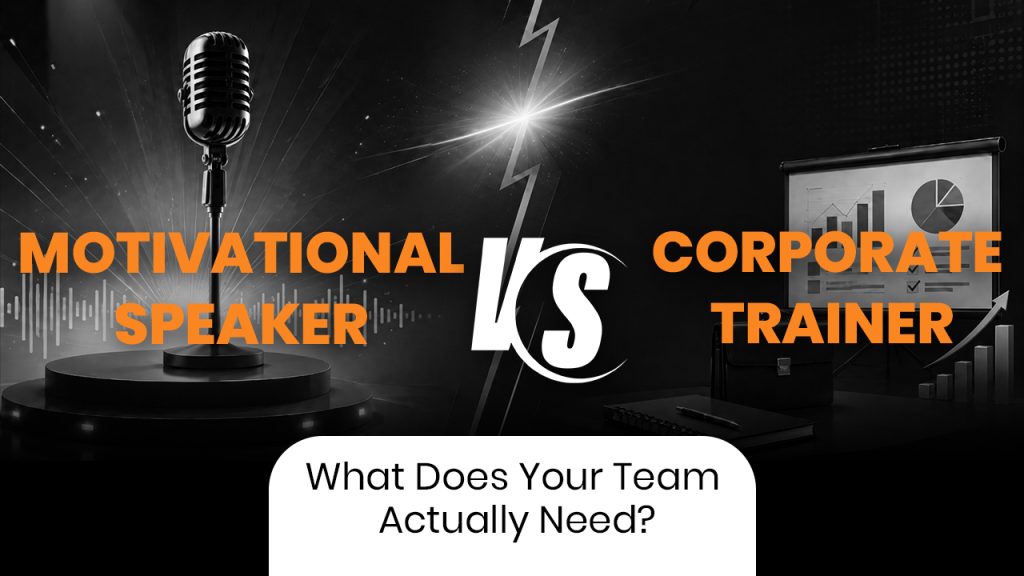
A motivational speaker and a corporate trainer are not exactly the same.
| Factor | Motivational Speaker | Corporate Trainer |
| Main Focus | Mindset, energy, purpose, action | Skills, tools, process, practice |
| Format | Keynote, talk, storytelling | Workshop, exercises, role-play |
| Best For | Events, kickoffs, morale, alignment | Skill development and behavior change |
| Duration | Usually shorter | Usually longer |
| Outcome | Inspiration with direction | Practical capability building |
For many companies, the best approach is to combine both.
For example, a company may start with a motivational keynote and then continue with sales training, leadership training, or manager coaching.
When Should a Company Hire a Motivational Speaker?
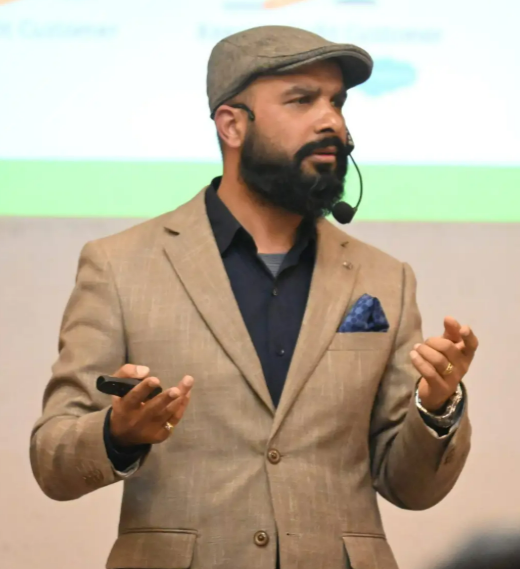
A company should consider hiring a speaker when there is a clear business or people-related reason.
Good situations include:
- Annual corporate events
- Sales target launch events
- Employee recognition programs
- Leadership retreats
- Team-building events
- Change management programs
- New financial year kickoffs
- Dealer or partner meets
- Performance improvement campaigns
- Corporate training programs
The speaker should not be selected only because the event needs “someone famous.”
The better question is: “What should employees think, feel, or do differently after this session?”
How to Choose the Right Motivational Speaker in Nepal for Corporate Events
Choosing the right speaker is important. A poor fit can feel generic. A good fit can make the event more meaningful.
Use this checklist before hiring.
| What to Check | Why It Matters |
| Business experience | Helps the speaker understand real workplace pressure |
| Audience fit | Sales teams, leaders, students, and employees need different messages |
| Practical framework | Avoids shallow motivation |
| Nepal market understanding | Makes examples relatable |
| Communication style | Keeps the audience engaged |
| Customization | Aligns the talk with your event goal |
| Follow-up option | Helps convert motivation into action |
| Credibility | Builds trust with the audience |
For corporate events in Nepal, the speaker should understand local workplace culture, communication style, sales pressure, and employee expectations.
What Should a Motivational Talk Include?
A good motivational talk should have structure.
It should not be a random collection of quotes.
A strong session usually includes:
- A clear theme
- Relevant workplace examples
- Stories that connect emotionally
- Practical lessons
- Audience reflection
- Simple action steps
- A closing message connected to business goals
For corporate training or employee events, the talk should be customized around the company’s industry, team size, event theme, and audience level.
For example, a sales team needs a different message than a leadership team.
How to Measure the Impact of a Motivational Speaker
Motivation can feel emotional, but companies can still measure whether the session created value.
Use simple pre-event and post-event indicators.
| Measurement Area | What to Track |
| Attendance | How many employees participated |
| Feedback score | How useful employees found the session |
| Key takeaways | What employees remembered |
| Action commitments | What employees agreed to do |
| Manager observation | Behavior changes after the event |
| Sales activity | Calls, visits, follow-ups, pipeline movement |
| Team culture | Communication, energy, collaboration |
| Retention signals | Employee sentiment and engagement |
The most useful question is not “Did people enjoy it?”
A better question is: “Did the session help people act better at work?”
Common Mistakes Companies Should Avoid
Hiring a motivational speaker can be valuable, but only if done properly.
Avoid these mistakes:
- Choosing a speaker only by popularity
- Not sharing event objectives in advance
- Expecting one speech to solve deep HR problems
- Booking a generic talk for a specific business issue
- Ignoring follow-up after the session
- Not involving managers after the event
- Measuring only entertainment value
- Using motivation as a replacement for fair systems
Motivational speaking works best when leadership also supports employees with clarity, tools, training, recognition, and good management practices.
Why Diwakar Rijal for Corporate Events in Nepal?
For companies looking for a motivational speaker in Nepal, Diwakar Rijal’s positioning is relevant because his work connects motivation with sales, leadership, and corporate training.
He is a leadership and sales trainer in Nepal with more than 20 years of experience and a focus on practical skills and systems.
He also has worked across industries such as insurance, corporate, pharmaceutical, healthcare, sales, and hospitality.
This matters because corporate audiences usually need practical relevance, not only emotional storytelling.
A strong speaker for corporate events should understand:
- Business targets
- Sales pressure
- Customer behavior
- Team accountability
- Leadership challenges
- Employee motivation
- Nepali workplace culture
For organizations planning corporate training, sales conferences, annual meetings, or employee engagement programs, this practical connection can make the session more useful.
Final Thoughts
The benefits of hiring a motivational speaker for corporate events go beyond temporary excitement.
A good speaker can improve morale, align teams, support leadership, build confidence, strengthen communication, and help employees reconnect with purpose.
For companies in Nepal, the best results come when motivation is connected with action, training, and follow-up.
A motivational speaker should not replace good leadership, fair policies, or proper corporate training. But the right speaker can create a strong moment of clarity that helps employees move forward with better energy and focus.
For corporate events, sales teams, leadership programs, and employee motivation sessions in Nepal, Diwakar Rijal offers a business-focused approach that connects motivation with execution and workplace performance.
FAQs
What are the benefits of a motivational speaker?
A motivational speaker helps improve employee morale, confidence, teamwork, communication, goal focus, and workplace energy. For corporate events, the main benefit is helping people reconnect with purpose and take action.
What is the main purpose of motivational talk?
The main purpose of a motivational talk is to inspire people to think differently, build confidence, overcome challenges, and take positive action toward personal or professional goals.
What are the qualities of a good motivational speaker?
A good motivational speaker is clear, credible, relatable, practical, emotionally intelligent, and audience-focused. They use real examples, structured messages, and actionable takeaways instead of only quotes or entertainment.
What skills do motivational speakers need?
Motivational speakers need public speaking, storytelling, audience engagement, emotional intelligence, research, communication, confidence, adaptability, and the ability to connect ideas with practical action.
Author: Diwakar Rijal
Diwakar Rijal is a motivational speaker, leadership trainer, and sales trainer in Nepal. His work focuses on corporate motivation, sales performance, leadership development, emotional intelligence, and practical execution for teams across Nepalese industries.