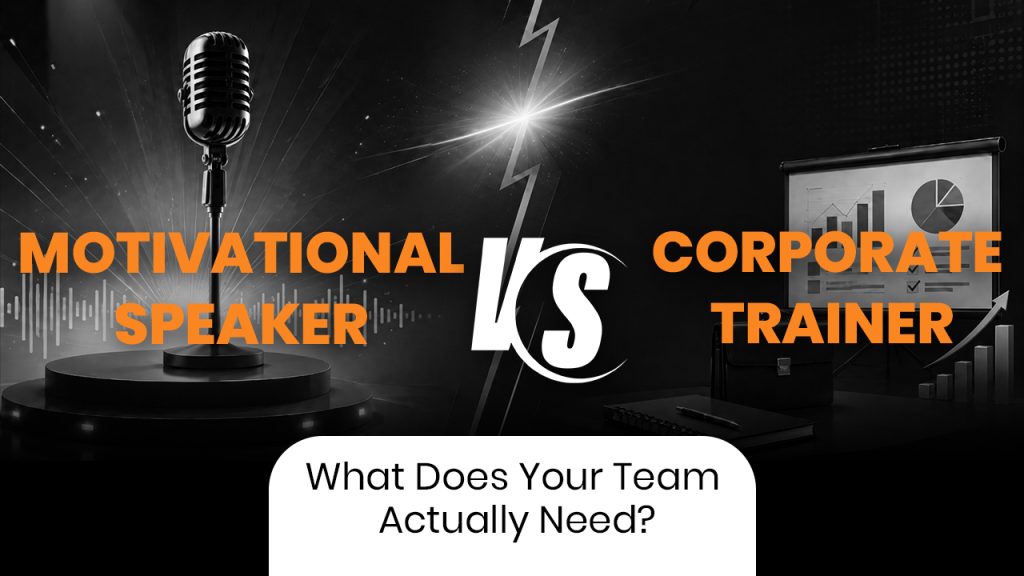
A motivational speaker inspires people to shift their mindset, rebuild energy, and take action. A corporate trainer builds specific workplace skills through structured learning, practice, feedback, and follow-up.
For many Nepali organizations, the question is not only whether to hire a motivational speaker in Nepal or a corporate trainer in Nepal. The better question is: what problem is your team trying to solve right now?
If your team lacks confidence, purpose, ownership, or emotional drive, a keynote-style session may help. If the team lacks sales skills, leadership ability, communication process, or execution discipline, training is usually the better fit.
Diwakar Rijal is a sales trainer and motivational speaker in Nepal, with services covering corporate sales training, sales leadership training, sales execution systems, and manager coaching. His site also emphasizes moving beyond basic motivation toward practical frameworks for measurable performance.

Why This Topic Matters for Teams in 2026
Workplace motivation is not just about positive thinking. It affects engagement, accountability, retention, customer experience, and performance.
Gallup’s State of the Global Workplace 2026 reported that global employee engagement declined to 20% in 2025, down from its 2022–2023 peak of 23%. It also found that manager engagement fell sharply, with managers at 22% engagement and individual contributors at 19%.
This matters because team performance often depends on daily leadership quality, not only annual speeches or one-time workshops.
At the same time, companies are still investing in learning and development. ATD reported that employees used an average of 17.4 formal learning hours per employee in its 2024 State of the Industry findings, down from 20.7 in 2022.
The lesson is simple: teams need inspiration, but they also need repeatable skills.
What Is a Motivational Speaker?
A motivational speaker is a professional speaker who helps an audience build confidence, energy, clarity, and willingness to act.
A good speaker does not only entertain. They connect emotionally with the audience, explain a meaningful message, and help people see a challenge differently.
In a workplace setting, a motivational session may focus on:
- Handling rejection
- Building resilience
- Improving attitude
- Strengthening ownership
- Managing change
- Developing confidence
- Creating team unity
- Reconnecting employees with purpose
A speaker in Nepal may also use local stories, Nepali business examples, market realities, and relatable workplace situations. This makes the message easier for the audience to understand and apply.
What Is a Corporate Trainer?
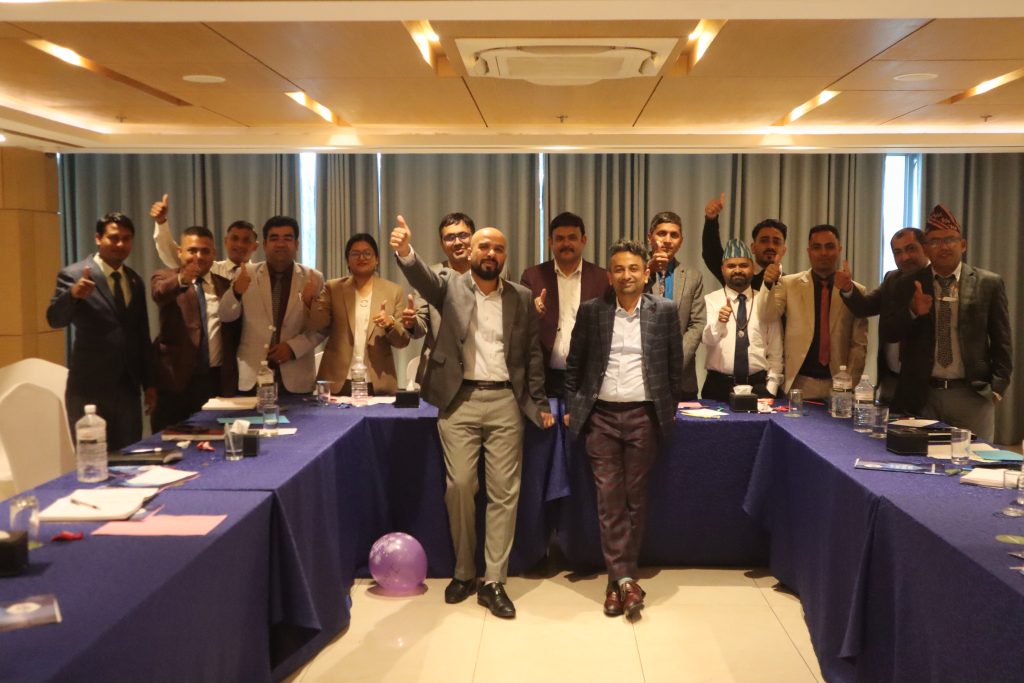
A corporate trainer is a learning and development professional who helps employees build job-related skills.
Unlike a keynote speaker, a trainer usually works with learning objectives, exercises, role plays, tools, assessments, feedback, and post-session improvement plans.
Corporate training may cover:
- Sales skills
- Leadership development
- Customer service
- Communication
- Negotiation
- Team management
- Presentation skills
- Conflict handling
- Performance management
- Manager coaching
A corporate trainer in Nepal should understand local team behavior, market conditions, buyer psychology, language preferences, and business culture.
For example, training a sales team in Nepal may require more than teaching scripts. It may include objection handling, follow-up discipline, relationship building, territory planning, and emotional resilience after rejection.
Motivational Speaker vs Corporate Trainer: Quick Comparison
| Factor | Motivational Speaker | Corporate Trainer |
| Main purpose | Inspire action and mindset shift | Build practical workplace skills |
| Session style | Keynote, talk, story-based session | Workshop, activities, exercises, coaching |
| Best for | Energy, confidence, change readiness | Skill gaps, process gaps, performance gaps |
| Duration | Often 45 minutes to 3 hours | Half-day, full-day, or multi-session program |
| Measurement | Audience response, energy, reflection, commitment | Skill improvement, behavior change, KPIs |
| Follow-up | Optional | Usually recommended |
| Best audience size | Medium to large groups | Small to medium focused groups |
| Output | Motivation, clarity, emotional connection | Skills, tools, action plans, practice |
Both roles are valuable. The right choice depends on whether the team needs emotional momentum or capability development.
When Does Your Team Need a Motivational Speaker?
Your team may need a motivational speaker when the main issue is mindset, morale, or emotional energy.
This is common after difficult business periods, leadership changes, missed targets, restructuring, market pressure, or long periods of stress.
A motivational session can help when employees are asking:
- Why should we keep pushing?
- How do we stay positive after rejection?
- How do we accept change?
- How do we work with more ownership?
- How do we reconnect with the company mission?
For example, a sales team that has missed targets for several months may not immediately need more technical sales theory. They may first need confidence, emotional reset, and a stronger reason to act.
In this case, a motivational talk can prepare the team for the next stage of training.
When Does Your Team Need a Corporate Trainer?
Your team needs a corporate trainer when the issue is not only motivation but skill, process, or execution.
Training is more suitable when employees say:
- We do not know how to handle objections.
- We struggle to close deals.
- Managers do not give effective feedback.
- Customer complaints are increasing.
- Sales follow-up is inconsistent.
- Team leaders lack coaching skills.
- Employees understand the goal but cannot execute it.
A trainer helps convert intention into behavior.
For example, a sales team may feel motivated after a powerful session, but if they do not know how to qualify leads, ask better questions, or negotiate professionally, motivation alone will not solve the problem.
This is where structured learning becomes important.
What Does Your Team Actually Need?
Use this simple diagnostic table.
| Team Situation | Better Choice |
| Low energy and low confidence | Motivational speaker |
| Poor sales conversion | Corporate trainer |
| New annual kickoff event | Motivational speaker |
| Weak leadership behavior | Corporate trainer |
| Team feels disconnected from purpose | Motivational speaker |
| Employees lack process discipline | Corporate trainer |
| Company launching change initiative | Both |
| Sales team needs mindset and skills | Both |
| Managers need coaching ability | Corporate trainer |
| Large event with many departments | Motivational speaker |
The best decision starts with the real problem.
If your team already knows what to do but lacks drive, motivation may help. If your team wants to improve but lacks skill, training is necessary.
Why Many Companies Need Both
In real business situations, motivation and training often work together.
Motivation opens the mind. Training builds the method.
A team may need a speaker to create urgency and belief. Then, it may need a trainer to teach the exact behaviors that produce better results.
For example:
A company can begin with a keynote on ownership and resilience. Then it can run a workshop on sales execution, customer follow-up, or leadership communication.
This is useful because employees often resist training when they do not feel emotionally connected to the goal. At the same time, employees may feel inspired after a talk but return to old habits without structured practice.
The strongest approach is often:
Inspiration → Skill building → Practice → Feedback → Follow-up
The Nepal Context: Why Local Experience Matters
A motivational speaker or corporate trainer working in Nepal should understand the local workplace environment.
Nepali teams often work across mixed language preferences, hierarchical structures, family business cultures, relationship-based sales, price-sensitive customers, and rapidly changing market conditions.
A speaker or trainer who understands this context can make the session more practical.
For example, a generic global sales example may not connect with a Nepali field sales team. But examples from Kathmandu, Lalitpur, Pokhara, Chitwan, Biratnagar, or regional distribution markets may feel more relevant.
This is especially important for industries such as:
- Banking and finance
- Healthcare
- Pharmaceuticals
- Education
- Real estate
- Retail
- Insurance
- FMCG
- Hospitality
- IT and services
Diwakar Rijal highlights corporate sales training, leadership training, execution systems, and manager coaching, with a focus on organizations in Nepal that want structured training rather than quick-fix seminars.
What Should a Good Motivational Speaker Deliver?
A good motivational speaker should deliver more than excitement.
The audience should leave with clarity, not only applause.
A strong session usually includes:
- A clear theme
- Relevant stories
- Practical takeaways
- Audience engagement
- Emotional connection
- Simple action steps
- Memorable message
For a business audience, the speaker should understand the company’s objective before the session.
For example, a sales team session should not sound the same as a student motivation session. A leadership team session should not sound the same as a general public event.
A useful motivational session is customized to the audience.
What Should a Good Corporate Trainer Deliver?
A good corporate trainer should help people practice and improve.
The training should not be only a lecture. It should include examples, discussion, activities, tools, and feedback.
A strong corporate training program usually includes:
- Training needs analysis
- Clear learning objectives
- Industry-specific examples
- Practical exercises
- Role plays or simulations
- Feedback and correction
- Action plans
- Follow-up support
For example, in sales training, the trainer may ask participants to practice opening conversations, identifying customer needs, handling objections, and closing professionally.
The goal is behavior change, not only information transfer.
How to Measure the Impact of a Session
Many organizations judge a session only by whether participants enjoyed it. That is not enough.
Enjoyment matters, but it does not prove business impact.
The Kirkpatrick Model is a widely used training evaluation model with four levels: reaction, learning, behavior, and results. It helps organizations look beyond attendance and satisfaction toward actual performance improvement.
Here is a practical way to measure impact.
| Evaluation Area | Motivational Speaker | Corporate Trainer |
| Reaction | Did people find it meaningful? | Did participants find training useful? |
| Learning | Did they understand the message? | Did they learn a new skill or method? |
| Behavior | Did attitude or ownership improve? | Did workplace behavior change? |
| Results | Did morale or engagement improve? | Did KPIs, sales, service, or leadership improve? |
Before hiring anyone, decide what success looks like.
For a motivational talk, success may be renewed energy and commitment. For training, success may be better sales conversion, improved customer handling, or stronger manager feedback.
Cost vs Value: How Should Companies Think?
The cheapest session is not always the best choice. The most expensive session is not automatically better either.
Companies should compare value, not just price.
Ask these questions:
- Does the speaker or trainer understand our industry?
- Can they customize the session?
- Do they provide practical takeaways?
- Can they handle our audience size?
- Do they have relevant experience?
- Can they connect with Nepali teams?
- Will the session support business goals?
- Is follow-up available if needed?
For a one-time event, a motivational speaker may be enough. For long-term performance improvement, training and coaching may create more value.
The right investment depends on the seriousness of the problem.
Common Mistakes Companies Make
Many companies hire a motivational speaker when they actually need training.
This happens when the team is underperforming and leaders assume the problem is attitude. Sometimes attitude is the issue. But often, employees are frustrated because they do not have the right tools, systems, or coaching.
The opposite mistake also happens.
Some companies arrange technical training when the team is emotionally tired, disconnected, or resistant to change. In that case, more information may not help until people are ready to engage.
Another common mistake is treating one session as a complete solution.
One event can create awareness. Lasting change usually needs reinforcement.
How HR and Business Leaders Can Decide
Before choosing a speaker or trainer, leaders should diagnose the real need.
Use this simple checklist.
Choose a motivational speaker if:
- The team needs energy
- Morale is low
- People are resisting change
- You are organizing a kickoff event
- Employees need confidence
- The goal is emotional connection
- You want a powerful shared message
Choose a corporate trainer if:
- Employees need specific skills
- Managers need coaching ability
- Sales results are inconsistent
- Service quality needs improvement
- Communication problems are repeated
- The team needs tools and practice
- You want measurable behavior change
Choose both if:
- The team needs mindset and method
- You are launching a transformation program
- Sales teams need confidence and skill
- Managers need inspiration and coaching tools
- The company wants long-term culture change
This approach helps avoid random spending.
Example: Sales Team Scenario
Imagine a sales team in Nepal that is missing monthly targets.
The salespeople are demotivated. They complain that customers only care about price. Managers keep pushing harder but do not coach better.
What does this team need?
A motivational speaker can help the team rebuild confidence, accept rejection, and reconnect with purpose.
A corporate trainer can help them improve prospecting, questioning, objection handling, closing, follow-up, and account management.
In this case, the best solution may be both.
Start with motivation. Then move into sales training. Then add manager coaching and follow-up.
This creates a complete path from mindset to measurable behavior.
Example: Leadership Team Scenario
Now imagine a company where department heads are technically strong but weak in people management.
Employees complain about unclear communication. Managers avoid difficult conversations. Team members do not receive useful feedback.
This is not mainly a motivation problem.
The company needs corporate training in leadership communication, coaching, accountability, and performance conversations.
A motivational talk may support the program, but it should not replace skill development.
Managers need tools they can use every week.
Example: Annual Event Scenario
For an annual conference, company anniversary, dealer meet, student program, or sales kickoff, a motivational speaker may be the better choice.
The goal is often to energize a large audience, create unity, and communicate a theme.
In this case, a highly structured workshop may not fit the event format.
However, the speech should still include practical takeaways. The best event sessions help people remember one clear message and act on it.
What Makes Diwakar Rijal Relevant for This Topic?
Diwakar Rijal presents him as a sales trainer in Nepal with corporate sales training, sales leadership training, sales execution systems, and manager coaching services. His work supports organizations that want sustainable sales performance and structured development, not only quick motivational seminars.
His motivational speaker page also emphasizes going beyond inspiration toward structured action for sales and corporate teams. This positioning matters because many companies do not need only a speech or only a workshop. They need a practical bridge between energy and execution.
For business teams, that combination can be useful when the goal is to improve sales behavior, leadership discipline, and team ownership.
How to Prepare Before Hiring a Speaker or Trainer
A successful session begins before the event day.
Share useful information with the speaker or trainer, such as:
- Team size
- Audience level
- Industry
- Current challenge
- Event objective
- Expected outcome
- Language preference
- Time available
- Previous training history
- Business priorities
Do not simply say, “Please motivate our team.”
A clearer brief creates a better session.
For example, say: “Our sales team is facing rejection and losing confidence. We want them to rebuild ownership and also learn practical follow-up discipline.”
That gives the facilitator a real direction.
How to Make the Session More Effective
Whether you hire a motivational speaker or a corporate trainer, the company must support implementation.
Here are practical steps:
- Set clear goals before the session
- Invite the right audience
- Explain why the session matters
- Ask managers to participate actively
- Collect feedback after the session
- Convert learning into action points
- Review progress after 30 days
- Reinforce key messages in meetings
Without follow-up, even a strong session can fade quickly.
Learning transfer needs repetition, manager support, and accountability.
CIPD notes that learning evaluation and transfer should be connected to organizational objectives, not treated as a separate activity.
Motivational Speaker vs Corporate Trainer: Final Decision
A motivational speaker is best when your team needs energy, belief, purpose, and emotional readiness.
A corporate trainer is best when your team needs skills, systems, practice, and measurable performance improvement.
For many businesses in Nepal, the best answer is not either-or. It is often a sequence.
Start with motivation when people need to believe change is possible. Follow with training when people need to learn how to change. Add coaching when managers need to sustain the change.
That is how organizations turn inspiration into execution.
Quick Answer Summary
| Question | Direct Answer |
| Who should hire a motivational speaker? | Teams needing energy, confidence, mindset shift, or event impact |
| Who should hire a corporate trainer? | Teams needing skills, behavior change, systems, or performance improvement |
| Which is better for sales teams? | Often both: motivation first, sales training next |
| Which gives measurable outcomes? | Corporate training is usually easier to measure |
| Which is better for large events? | Motivational speaking usually fits better |
| Which is better for long-term change? | Corporate training plus follow-up coaching |
FAQs
Who is the best motivation speaker?
The best motivation speaker depends on your audience, goal, industry, and expected outcome. For Nepali corporate and sales teams, choose a speaker who understands local business challenges, uses relevant examples, and gives practical action steps.
What do motivational speakers do?
Motivational speakers inspire people to improve mindset, confidence, focus, resilience, and action. In companies, they help teams reconnect with goals, handle challenges, accept change, and build stronger ownership.
What are the 7 rules of motivation?
The 7 practical rules of motivation are: set a clear goal, connect work with purpose, build daily discipline, track progress, manage energy, learn from failure, and stay accountable through action.
What is a corporate trainer?
A corporate trainer is a professional who teaches employees workplace skills such as sales, leadership, communication, customer service, teamwork, and management through structured training sessions.
What is the role of a corporate trainer?
The role of a corporate trainer is to identify skill gaps, design learning sessions, teach practical methods, guide practice, give feedback, and help employees apply new skills at work.
Author Bio
Written by Diwakar Rijal
Diwakar Rijal is a Nepal based motivational speaker, sales trainer and corporate training professional focused on sales performance, leadership development, manager coaching, and practical team execution. His work supports organizations that want to move beyond short-term motivation and build sustainable workplace performance.