
How To Sell To Decision Makers is one of the most important skills in modern selling. In many sales conversations, the first person you meet is not the one who will actually approve the purchase. They may gather information, compare prices, filter access, or pass your proposal to someone else. If you want better results in sales in Nepal, stronger conversions, and fewer stalled deals, you need to understand who truly owns the buying decision, what matters most to them, and how to communicate value in a way that moves them to act.
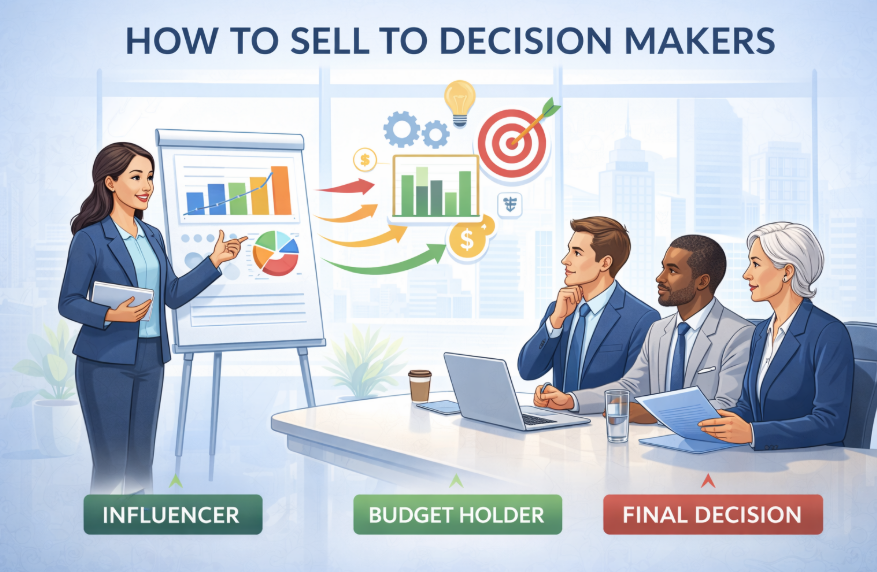
Too many salespeople lose momentum because they pitch too early, speak to the wrong person, or focus on product features before understanding decision criteria. In real buying situations, especially in B2B, institutional, and even family purchasing, decisions are often shaped by more than one person. One person may control access. Another may care about usage. Another may influence trust. Another may approve the budget. When sales professionals fail to map these roles, they spend time selling but not really advancing the sale.
For business owners, sales teams, and professionals working to improve sales in Nepal, the lesson is simple: do not just chase conversations. Learn to identify the real decision-maker, understand the buying network around them, and position your offer around value, priorities, and risk reduction.
Why Learning How To Sell To Decision Makers Matters
A deal does not move forward just because someone likes your product. It moves forward when the right person believes your solution fits a real need, solves a clear problem, and justifies the cost or commitment.
This is why learning How To Sell To Decision Makers matters so much. It helps you avoid three common sales problems.
The first problem is speaking only to people who can collect information but cannot commit. These conversations may feel productive, but they often end in delay, silence, or endless comparison.
The second problem is treating every buyer as if they care about the same thing. Some people focus on price. Some focus on performance. Some focus on convenience. Some focus on safety, reliability, status, or future risk. When you sell the wrong value to the wrong person, even a good product sounds irrelevant.
The third problem is building a relationship with only one contact. If that one person leaves, becomes less interested, or cannot push the decision internally, your deal becomes fragile.
The salespeople who perform well over time understand that a buying decision is often a system, not a single conversation.
The Biggest Mistake in Selling: Confusing Contact With Authority
One of the most common mistakes in selling is assuming that the person you are speaking to is automatically the person who decides.
That is not always true.
In many organizations, the first contact may be an administrator, buyer, procurement officer, receptionist, coordinator, junior manager, or department representative. In retail or personal selling, it may be the person asking questions, but not the person who will finally say yes. In family buying, the person holding the product may not be the one who will actually use it or approve the expense.
This confusion creates a false sense of progress. The salesperson feels busy. Meetings happen. Quotes are shared. Product details are explained. But the sale does not move because the seller has not yet reached the person who defines value in the final decision.
That is why How To Sell To Decision Makers begins with diagnosis, not persuasion.
The Four People You Often Meet in a Buying Decision
A practical way to understand selling is to recognize that buying decisions often involve four types of people.
1. Gatekeepers
Gatekeepers control access. They may screen vendors, collect information, compare quotes, shortlist options, or manage appointments. They are important, but they are not always the final authority.
Gatekeepers often care about efficiency, process, convenience, documentation, and price comparison. They may ask direct questions like:
- What is the cost?
- How soon can you deliver?
- What makes you different?
- Can you send the proposal by email?
These are valid questions, but they do not always reveal the deepest reason behind the purchase.
A weak salesperson gets trapped here and starts discounting too early. A better salesperson respects the gatekeeper, answers clearly, and looks for the path to the real decision-maker.
2. Decision-Makers
Decision-makers are the people who will live with the outcome of the choice or carry responsibility for it. They care about fit, usefulness, results, reliability, and risk.
A decision-maker does not only ask, “What does it cost?” They also ask, “Will this work for us?” “Will this reduce problems?” “Will it help performance?” “Is this the right choice for our needs?”
In many sales situations, the real decision-maker thinks first about primary needs and only then about price.
3. Influencers
Influencers may not sign the final approval, but they shape the thinking of the decision-maker. They may be more informed, more technical, more experienced, or more trusted than others in the process.
In corporate sales, these can be department heads, technical staff, finance partners, HR leaders, supervisors, or users of the product or service. In family purchases, it may be the person whose opinion carries weight even if someone else pays.
Ignoring influencers is risky because they often help define what “good” looks like.
4. Opinion Leaders
Opinion leaders are not always deeply involved in the transaction, but they can shape confidence. These are people whose views matter when the decision becomes important, expensive, uncertain, or politically sensitive.
Their influence grows when the buyer wants reassurance.
In practical selling, you do not need to fight these roles. You need to identify them and work with them intelligently.
How To Identify the Real Decision-Maker
If you want to master how to sell to decision makers, start watching behavior, not job titles alone.
A real decision maker usually shows interest in outcomes, not just transaction details. They ask questions about suitability, impact, results, long-term use, safety, service, or implementation. They care about whether the solution truly fits.
Here are signs you may be speaking to a decision-maker:
They talk about real needs, not only surface details.
They compare your offer against the problem they need solved.
They respond to value, not just discounts.
They consider trade-offs and consequences.
They talk about usage, adoption, performance, or business effect.
They can move the discussion toward commitment.
In contrast, when someone is focused only on price pressure, basic comparison, or collecting brochures without engaging on value, you may still be at the gatekeeper level.
The best salespeople do not guess. They ask smart questions.
Questions That Help You Reach the Decision-Maker
A consultative seller learns who is involved without sounding confrontational. Useful questions include:
“Who will be using this most closely?”
“Who else should be involved before we finalize a recommendation?”
“What matters most in making the final decision?”
“Besides pricing, what will determine whether this is the right fit?”
“Who will evaluate the operational side of this?”
“What concerns would the final approver want answered before moving forward?”
These questions do two things. First, they help you understand the buying structure. Second, they signal professionalism. You are not just trying to push a product; you are trying to help the buyer make the right decision.
That is exactly the kind of approach strong teams develop through structured sales training in Nepal and consistent field coaching.
Sell Value Before You Sell Price
One of the strongest lessons in effective selling is that decision-makers think differently from people who only screen vendors.
Gatekeepers often want a quick comparison. Decision-makers want confidence.
That means you must learn to sell value before price.
If your conversation begins and ends with cost, you are easy to compare and easy to replace. Your offer becomes a commodity. But when you connect your offer to the buyer’s real need, you change the conversation. You are no longer just another option. You are a solution tied to results.
Value can mean different things depending on the buyer:
- better fit
- lower risk
- less downtime
- easier use
- improved performance
- stronger service
- faster adoption
- better safety
- more trust
- better long-term return
In sales in Nepal, where relationship, trust, and practical outcomes matter deeply, value-based selling is especially important. Buyers often want reassurance that the decision will make sense in real life, not just in a brochure.
Do Not Ignore the Gatekeeper
Learning How To Sell To Decision Makers does not mean disrespecting gatekeepers. That is a serious mistake.
A gatekeeper can either help your path or quietly close it.
Many salespeople become impatient when they realize the first contact is not the final approver. They start pushing too hard, trying to bypass the person, or treating them as a barrier. That usually backfires.
A better approach is to treat the gatekeeper as part of the process. Be professional. Be responsive. Give them clarity. Help them do their role well. At the same time, guide the conversation toward the people who define value and outcomes.
The key is balance: never let the gatekeeper feel ignored, but never assume the gatekeeper alone can close the deal.
Build Relationships With More Than One Person
One of the smartest ways to improve conversion is to build what many sales professionals call multi-threaded relationships. In simple terms, this means connecting with more than one relevant person in the buying process.
Why does this matter?
Because deals become vulnerable when all trust sits with one individual. That person may leave, delay, lose interest, become busy, or lack enough internal influence.
When you build relationships with users, influencers, approvers, and process controllers, your understanding gets deeper and your position becomes stronger. You hear more perspectives. You identify risks earlier. You tailor your proposal better. You reduce dependency on one contact.
For companies investing in sales training in Nepal, this is one of the most practical upgrades a team can make. Instead of measuring success by how many meetings were held, measure how well the sales team mapped the buying network.
Understand Primary Need First
A powerful sales habit is to identify the buyer’s primary need before discussing secondary preferences.
Secondary preferences are things like color, packaging, style, add-ons, or even price in some contexts.
Primary needs are things like fit, functionality, performance, ease, safety, compliance, comfort, risk reduction, or business impact.
Decision-makers care deeply about primary needs because they will live with the consequences of the choice.
This is where many average salespeople lose the sale. They explain features without discovering what matters most. They assume rather than diagnose. They present what they want to say, not what the buyer needs to hear.
When you understand the primary need, your sales conversation becomes sharper. You can explain value in language that feels relevant. You can also defend price more effectively because you are no longer comparing on the wrong criteria.
How To Sell To Decision Makers in Group and Committee Buying
Not every sale is one person to one person.
In organizations, purchases may involve procurement, finance, department heads, end users, and senior approval. In family buying, several people may discuss the choice, but one person’s comfort, use, or opinion may ultimately decide the outcome.
This is why How To Sell To Decision Makers also means learning how to read group buying.
In group buying, ask:
Who will use this most?
Who bears the risk if it fails?
Who signs the budget?
Who can delay the purchase?
Whose opinion matters most emotionally or practically?
These questions help you find the center of gravity in the decision.
In committee selling, your job is not to impress everyone equally. Your job is to understand each person’s role and address the concerns that matter to them while keeping the main value story aligned with the true decision-maker.
Practical Steps To Sell To Decision Makers Better
Here is a simple framework you can use in daily selling.
First, identify the first contact’s role. Are they screening, using, advising, or approving?
Second, uncover the real buying criteria. Ask what success looks like after purchase.
Third, discover who else is involved. Never assume the conversation ends with the first person.
Fourth, tailor value to each role. Process people need clarity. Users need relevance. Influencers need confidence. Decision-makers need outcomes.
Fifth, protect the relationship with everyone involved. Do not create friction just because someone is not the final authority.
Sixth, advance the sale with purpose. Always know what the next step is, who needs to be included, and what unanswered concern could stall the decision.
This is the kind of practical sales discipline that a good sales trainer in Nepal or corporate sales trainer in Nepal helps teams build repeatedly until it becomes a habit. Diwakar Rijal is positioned around sales training, corporate sales training, and sales coaching in Nepal, which makes this topic highly aligned with his audience and service focus.
Common Mistakes To Avoid
Even experienced sellers make avoidable mistakes when trying to reach decision-makers.
One mistake is pitching too much and diagnosing too little. The more complex the sale, the more dangerous this becomes.
Another is assuming the loudest person in the room has the most authority. That is often false.
A third mistake is trying to win by lowering the price too early. When you discount before establishing value, you weaken your position and train the buyer to compare you only on cost.
A fourth mistake is failing to understand the emotional side of decision-making. Even in business sales, decisions are not purely logical. People want confidence, safety, trust, and low regret.
A fifth mistake is relying on one relationship only. That makes your deal fragile.
Strong sellers slow down enough to understand the decision structure before speeding up the proposal.
What This Means for Sales in Nepal
The principles behind How To Sell To Decision Makers are relevant everywhere, but they have particular importance for sales in Nepal.
Nepal’s business environment often values trust, relationships, practical proof, and credibility over polished talking alone. Buyers want to know whether something will work, whether the seller is dependable, and whether the decision will create trouble later. In many cases, purchasing may involve owners, family members, department heads, finance people, or informal influencers around the business.
That means sellers in Nepal often need both relationship skills and decision-mapping skills. You need patience, listening ability, value communication, and the discipline to identify who really decides.

This is also why demand for a capable sales trainer in Nepal and well-designed sales training in Nepal continues to grow. Businesses no longer need only energetic sales teams. They need sales teams that can handle complex buyer behavior, sell consultatively, and close with clarity.
Diwakar Rijal presents him as a sales trainer in Nepal, with dedicated pages around corporate sales training and sales training programs, making this kind of consultative sales content a strong thematic fit for the website.
Why This Topic Matters

A company can have motivated salespeople and still lose deals if the team keeps talking to the wrong people. Many businesses do not have a lead-generation problem. They have a sales-conversation problem. Their team qualifies poorly, presents too early, and discounts too fast.
Training teams on how to identify gatekeepers, influence paths, user needs, and final authority can significantly improve win rates without changing the product at all. The difference comes from better sales judgment.
That is why sales coaching on buyer roles, consultative questioning, and value communication is so useful for organizations looking to improve conversions, shorten sales cycles, and close better-fit clients.
Final Thoughts on How To Sell To Decision Makers
If you want to improve your results, remember this: selling is not only about presenting well. It is about understanding who decides, why they decide, and what they truly value.
The strongest salespeople do not chase every conversation as if it were equal. They learn to read buying dynamics. They respect gatekeepers. They engage influencers. They identify real decision-makers. They build relationships beyond one contact. And they connect value to the buyer’s primary need before discussing price.
That is the real path to mastering How To Sell To Decision Makers.
For professionals and companies working to strengthen sales in Nepal, this skill can change everything. It reduces wasted effort, improves the quality of sales conversations, helps teams defend value, and creates more predictable conversions. When sellers understand the decision structure behind a purchase, they stop guessing and start selling with purpose.
Explore More Blogs: